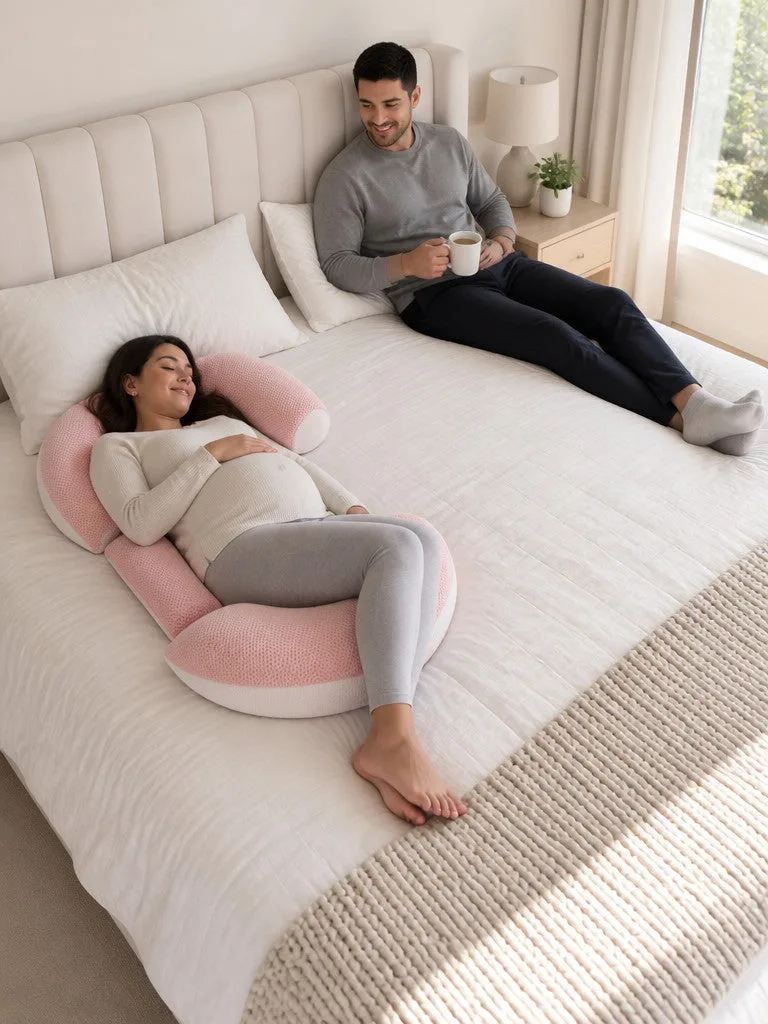
A connected adjustable pregnancy pillow and a full-body pillow organize your bedding differently. Choose between them by the areas you want to cushion and the pieces you are willing to rearrange. Neither label establishes which pillow will feel better to you.
There is also an important overlap: a full-body pillow can be adjustable. “Full-body” describes the pillow's coverage or layout; “adjustable” should describe a specific feature. This guide compares a compact, connected two-cushion arrangement with a long body-pillow arrangement. It is not a clinical comparison or a hands-on product test.
First, identify which design the listing means
A connected pillow usually has two smaller cushions joined by fabric or a strap. Some let you set the distance between the cushions; others have a fixed or stretchy connecting panel. Do not assume those are the same adjustment.
A full-body pillow has a longer section intended to run alongside or around the body. Straight, curved, C-shaped, and U-shaped designs are not identical. Some include detachable sections or adjustable filling.
The mechanism matters more than the word on the listing. For instance, bbhugme's instructions describe adjusting firmness with fasteners at the ends of its long pillow. This is an example of adjustability within the body-pillow category.
Compare the setup, not just the silhouette
| Decision | Connected two-cushion arrangement | Long full-body arrangement |
|---|---|---|
| Where do I want cushioning? | Check the intended positions of the two smaller cushions | Check which sections reach the areas you want to cushion |
| Do I want to keep my head pillow? | Check whether any component sits under the head | Check the top section and the maker's alternative arrangements |
| Do I want something to hug? | A pair of small cushions may leave that job to a separate pillow | A long front section may provide the shape you want |
| What changes when I turn? | Check whether the connected pieces can remain arranged as instructed | Check whether you must move one long section or reposition the whole pillow |
| What can I adjust? | Gap, cushion position, or firmness only if the model allows it | Sections, fill, firmness, or shape only if the model allows it |
| What do I need to clean? | Check each cushion, connecting section, and cover | Check the long insert, cover, and any detachable pieces |
The table is a set of inspection questions. It does not predict comfort or prove that a design prevents movement during sleep.
When the connected arrangement is worth considering
Start with this style when your main requirement is a pair of smaller cushions and you are happy to keep other bedding separate.
It may be a useful candidate if you already like your head pillow, do not want a long section in front of your upper body, or want to investigate a model with a clearly specified gap adjustment. Confirm those features in that model's instructions; the category name does not guarantee them.
The tradeoff is that you may still want a separate pillow for another part of your setup. Count all the pieces you expect to use. A compact main pillow can still produce a multi-piece routine.
Before ordering, ask the seller to show the connector, explain its adjustment range, and identify whether the two cushions can be removed from their covers independently. A stretchy middle panel is not necessarily a setting that you can lock at a chosen width.
When the long arrangement is worth considering
Start with a full-body design when you want to investigate one continuous cushion that you can hug or position along more of your body.
Look closely at its shape. A long straight pillow and a wraparound U shape can require different movements to reposition. If you want to keep your head pillow, check whether the upper section can stay out of its way or detach as the manufacturer permits.
The tradeoff is handling the longer piece. Think through getting settled, changing sides, getting up, removing its cover, and storing it during the day. These are practical considerations rather than evidence that a larger pillow is less comfortable.
A full-body label also does not establish length for your body. Ask for the measurements shown on a diagram of the actual model; do not infer reach from a photograph of someone else using it.
Walk through one ordinary night before choosing
Use the manufacturer's arrangement as your starting point, then answer these questions for each candidate:
- Where will my usual head pillow go?
- Which section will I hold or rest alongside?
- Will I need an additional pillow, and where will that go?
- When I change sides, which pieces need moving?
- When I get out of bed, which section would I have to move?
- Can I remove and replace the cover in a way I can manage?
You can sketch the pieces or use the bedding you already own to think through the movements. That is a planning exercise, not a way to reproduce another pillow's firmness or certify its fit.
If room for two adults is the deciding factor, continue with the small-bed and shared-bed fit checklist. This comparison concentrates on handling and layout, while the fit guide covers the space check.
Do not let the shape answer the care question
The pillow's outline does not tell you which parts can go in a washing machine. Check the exact cover and insert instructions, whether spare covers fit that version, and where the cleaned components can dry.
For either design, also check return eligibility before using it as a home trial. A longer return window is only useful if the policy permits returning the item in the condition you expect.
Which one should you choose?
Consider the connected arrangement first when you want smaller components around specific areas and are comfortable using separate bedding for the remaining jobs. Consider a long pillow first when a continuous cushion is the feature you want and you are prepared to handle that longer piece.
If both seem suitable, choose two actual models and use our pregnancy pillow buying checklist to compare their manuals, adjustment details, care instructions, and return conditions. You have not narrowed the decision enough if the only differences you can list are “adjustable” and “full-body.”
If pain is driving the purchase, our guide to hip pain at night in pregnancy explains when to ask your care team for help. This layout comparison cannot identify a treatment or a safer sleeping position for your individual pregnancy.
Prepared by Relvay Editorial. Relvay sells pregnancy pillows. This guide compares design features and questions to ask; it does not rank tested products or claim one type is medically superior. Sources checked October 7, 2026. See our editorial policy.