

Relvay makes a pregnancy pillow. We also tell you below when you should not buy one.
The short answer
No, you don't strictly need a pregnancy pillow. It is not a medical requirement, and for most people regular pillows can work. The NHS suggests going to sleep on your side, with pillows supporting your bump and one between your knees.
- Skip it if your pillows stay put.
- Get one if you rebuild them every night.
- What matters: support that turns with you.
2:47 a.m., again
Most pregnant side sleepers reach a point, usually in the second trimester, where regular pillows stop staying where you put them. This is what that point feels like.
2:47 a.m.
That was the number on the clock the night I finally cried about pillows. I was 29 weeks. I had gone to bed at eleven with everything perfect: one pillow under my bump, one between my knees, one jammed behind my back.
Then I turned over to pee. When I came back, the one behind me was gone. The one between my knees was on the floor. I lay there rebuilding the whole thing in the dark, trying not to wake Jake, and I remember thinking: I used to be good at sleeping.
It was not one bad night. It was 1 a.m., 3 a.m., 5 a.m., every night, for weeks. I was tired at work, short with Jake, and scared of going to bed, which is a strange thing to feel about a bed.
- If you go to bed with a perfect setup and wake up with half of it on the floor...
- If you dread the moment you have to turn over...
- If your hips ache by morning even though you did everything the midwife said...
- If your partner is now sleeping on the last ten inches of the bed...
You are not doing it wrong. Your pillows were never designed to stay where you put them.
"I really tried to get away with using regular pillows but they shift and I was sleeping terribly."Pregnancy pillow customer review
"I just use multiple regular pillows. I don't want to store the jumbo one."r/pregnant, Reddit
"Once you start getting pelvic pressure or even belly tightness, the pregnancy pillow is key."r/BabyBumps, Reddit
What most of us try first
Most people try more regular pillows, then a big U or C pillow, then a single wedge. Each one fixes one problem and costs you something else.
- One extra pillow between the knees.It helped my hips for about an hour. Then I moved my legs and it slid out, and I woke up twisted.Good idea, but nothing keeps it there.
- A tower of three or four regular pillows.Bump, back, knees, all covered. But nothing connects them, so every turn meant rebuilding in the dark. Silky pillowcases made it worse.Right support, three loose parts.
- The giant U pillow.It finally stayed put, because it surrounded me. It also swallowed our queen bed. A typical U pillow is about 59 to 63 inches long and 28 to 31 inches wide, and a queen is 60 inches wide. Jake ended up on the edge with one arm hanging off. Turning over felt like climbing out of a boat. And for the first time since we got married, he could not hold me at night. "Took up a ton of our bed and we have a queen." (Amazon review of a U-shaped pillow) · It stays together by taking the bed, and the cuddle.
- A single small wedge.Takes no space, but it only holds one thing: the bump or the back, never both.Small enough, but half the job.

Why do regular pillows stop working?
Regular pillows stop working because side sleeping in pregnancy needs support in three places at once, and loose pillows move apart every time you turn.
Under the bumpSo its weight is not pulling you forward and twisting your back.
Behind the backSo your lower back has something to lean into when you relax.
Between the kneesSo your top leg does not drop and pull on your hip.
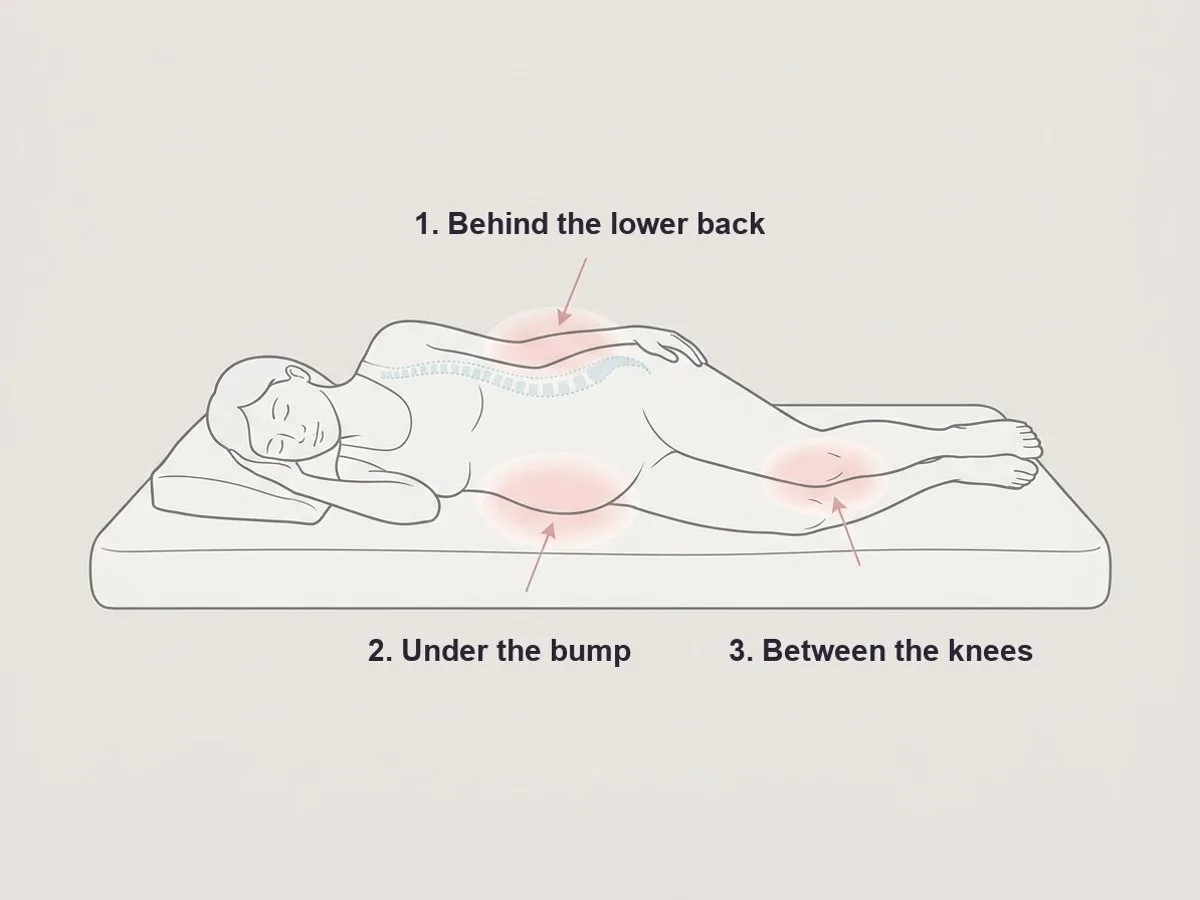
The big U and C pillows fixed the drifting by making the pillow one huge piece. That works, but it trades a drifting problem for a bed-space problem.
The missing piece was never a bigger pillow. It was support that stays connected when you turn.
That one idea is what finally gave Megan her nights back, and it does not need half the bed. Keep reading: first the free fixes, then what worked.
Why does sleep get harder as pregnancy goes on?
Your bump gets heavier, your centre of gravity moves forward, and hormones loosen the ligaments around your pelvis. Lying on your stomach stops being possible and lying on your back starts to feel heavy. From the third trimester the NHS advises going to sleep on your side, and either side is fine.
So side sleeping becomes the default for months, often for someone who has never slept that way. That is when the right support starts to matter.
Is it okay not to use a pregnancy pillow?
Yes. Before you buy anything, try a proper regular-pillow setup for a few nights:
- Keep your normal head pillow. Your neck should stay level with your spine.
- Put a firm pillow between your knees and ankles, not just your knees, so the top leg stays level.
- Fold a pillow under your bump so it feels lifted rather than hanging.
- Wedge a pillow behind your lower back, pushed in tight against the mattress so it does not roll away.
- Notice what happens when you turn. That is the real test.
If you wake up rested and the pillows are mostly where you left them, you do not need to buy anything. Seriously. Keep the money.
When is a pregnancy pillow worth it?
A pregnancy pillow is worth it when your regular pillows keep falling apart at night. Tick the ones that sound like your week:
- I wake up at night to rebuild my pillows.
- I dread turning over.
- My hips or lower back ache when I wake up.
- Getting up to pee means rebuilding everything.
- My partner is running out of room.
- I keep adding pillows every week.
Two or more? Your regular pillows have stopped doing the job, and a pregnancy pillow is likely worth it. There is no set week to start. Many people reach this point in the second trimester, and it matters most from 28 weeks when side sleeping is the advice.
Ongoing or sharp hip, pelvic or back pain is something to raise with your midwife, GP or a women's health physiotherapist. A pillow is a comfort aid, not a treatment.
Will a pregnancy pillow fit your bed?
It depends on the pillow's width. Each person gets about half the mattress, and a full-length U pillow is 28 to 31 inches wide.
| Bed (US standard width) | Your half | U pillow (28 to 31 in wide) | Compact bump-and-back set |
|---|---|---|---|
| Full, 54 in | 27 in | Wider than your half | Stays on your half |
| Queen, 60 in | 30 in | About your whole half | Stays on your half, room to move |
| California king, 72 in | 36 in | Fits, little spare room | Fits easily |
| King, 76 in | 38 in | Fits | Fits easily |
On a king, almost any pillow works. On a full or queen, the pillow's footprint decides whether your partner keeps sleeping next to you.
Which type of pregnancy pillow should you choose?
Choose the type that fixes your actual problem: drifting pillows, bed space, or turning over. Here is how the main types compare.
| Regular pillows | U or C pillow | Single wedge | Two wedges strapped together | |
|---|---|---|---|---|
| Stays together when you turn | No | Yes | Can slide | Yes |
| Supports bump and back | With 2 or more pillows | Yes | One or the other | Both |
| Bed space | Flexible | Fills much of a queen | Very little | Stays on your half |
| Turning over | Rebuild each time | Can feel boxed in | Easy | Set turns with you |
| Partner can still hold you | Yes | Hard | Yes | Yes |
Also check the care label, and a return window long enough to actually sleep on it for a few weeks.
What changed when the support stayed connected?
When bump and back support are joined, you can turn over without rebuilding anything, and the bed stays shared.
Megan switched to two small wedges joined by a strap: one under her bump, one behind her lower back, a regular pillow still between her knees. The first night she noticed only one thing. She turned over at 3 a.m. and everything came with her.
A week later she was sleeping mostly through the night. Jake got his side of the bed back. And on Sunday morning, for the first time in two months, he rolled over and held her, bump and all.

Frequently asked questions
Is it okay not to use a pregnancy pillow?
Yes. It is not a medical requirement. The NHS suggests supporting your bump with pillows and a pillow between your knees, and regular pillows can do that. It becomes worth buying when they keep moving apart at night.
Is it worth it to get a pregnancy pillow?
It is worth it if you wake up to rebuild your pillows, or your setup is pushing your partner out of bed. If regular pillows stay in place and you sleep well, keep using them.
At what week do you need a pregnancy pillow?
There is no set week. Many people start in the second trimester. The NHS advises going to sleep on your side from 28 weeks, so support that keeps you there matters most from then on.
Which side should I sleep on when pregnant?
Either side. The NHS says either side is fine, so pick the one that feels comfortable.
Is a U-shaped pillow better than a wedge?
A U supports both sides but a typical one is about 59 to 63 inches long and 28 to 31 inches wide. A single wedge is small but supports one area. Two wedges joined together cover the bump and back without filling the bed.
Can you wash a pregnancy pillow?
It depends on the model. Some have a removable cover you can machine wash, others are spot-clean only. Check the care label before you wash any filled piece.
Where the Relvay 3-Piece pillow fits in
The Relvay 3-Piece is the two-wedge set Megan's story describes, made for the gap between regular pillows that fall apart and a giant U that takes the bed.
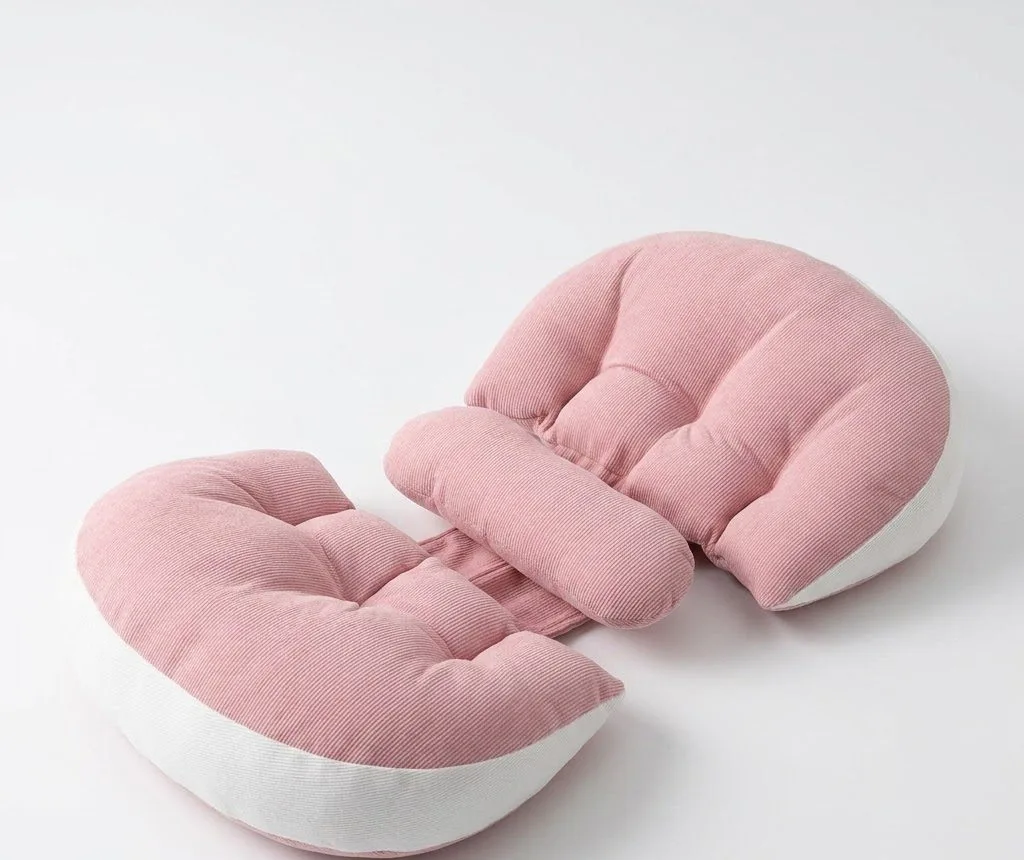
1. The bump wedgeA crescent-shaped wedge that tucks under your bump, thin edge toward your belly button, so the weight is not pulling on your back.
2. The back wedgeThe same shape, snug against your lower back so it has something to rest against.
3. The strap and small cushionA flat strap runs under you and joins the two wedges, so the set turns with you. A small oval cushion sits on the strap between them. You can set the distance as the bump grows.
Each wedge is about 17 by 13 inches and about 4 inches thick at its outer edge, tapering thinner toward your body (supplier measurement). Opened out, the set is roughly as wide as your torso, so it stays on your half of the bed and you keep your normal head pillow. Soft ribbed pink fabric on top, white sides, polyester filling. It is light enough to pack for a trip.
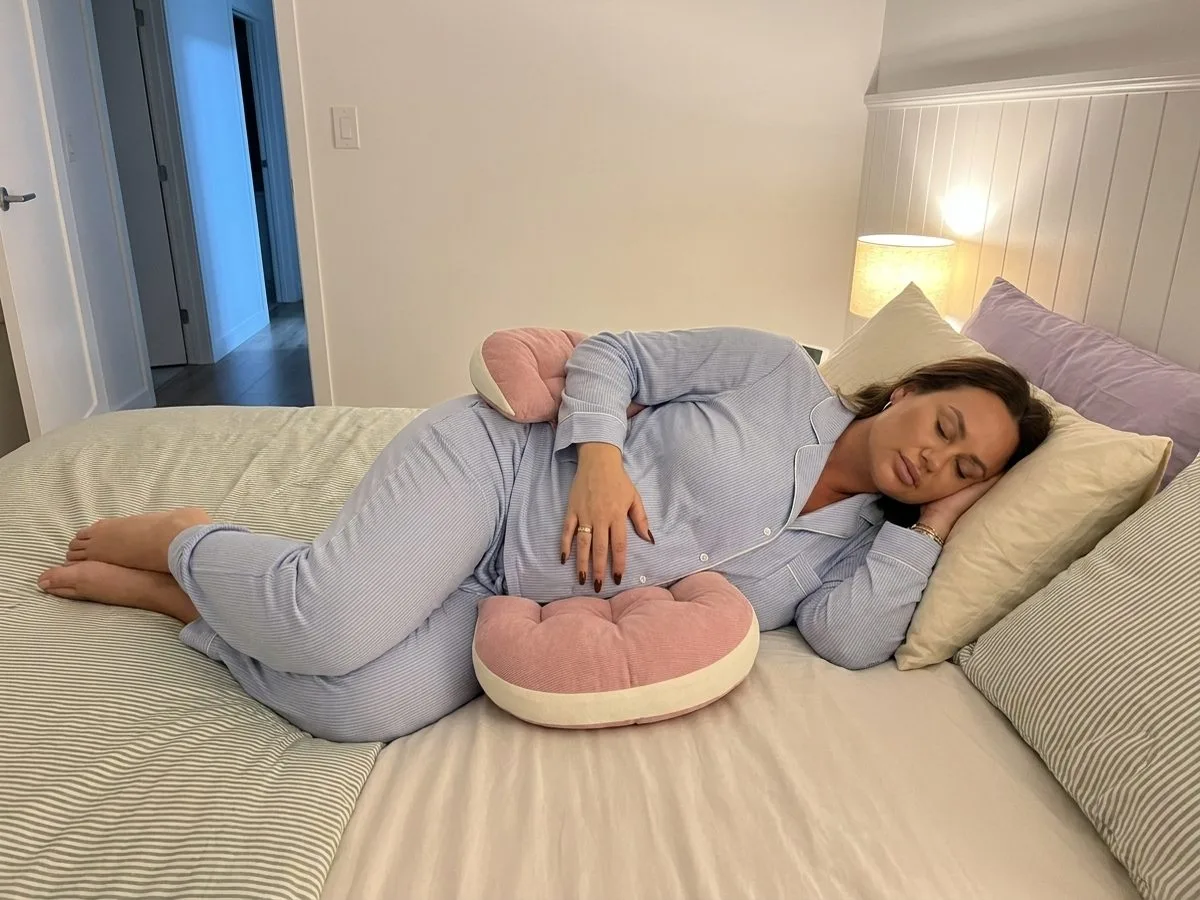
What it does not do: it does not go between your knees. Keep a regular pillow there, the way the NHS suggests. That combination covers all three points without a giant pillow.
Probably not for you if
- Regular pillows stay put and you sleep well.
- You want one pillow that also wraps your head and knees.
- Your main problem is pain that needs a doctor's advice first.
Made for you if
- You ticked two or more boxes above.
- You share a full or queen bed.
- You want bump and back support that does not fall apart at 3 a.m.
Try it for 90 nights
Sleep on it through the weeks that matter. If it is not right for you, email us within 90 days of delivery for your money back.
$79.99
90-day money-back guarantee · Free US shipping over $70 · 3 pieces, one set
Check price and availabilityMegan's story is a composite based on real reviews and public posts from pregnant side sleepers. Names and details are changed.