Relvay makes a pregnancy pillow. We also tell you below when you should not buy one.
The short answer
A heated pregnancy pillow is two products: a pillow and an electric heating device. Judge the heater by its label and manual, not by the pillow's marketing, and ask your midwife or OB-GYN whether heat fits your pregnancy before you plug it in.
- Check: model number, safety mark, auto shut-off, intended use.
- Ask: where on your body, which setting, how long, for you.
- Skip: sleeping with it switched on.
What is a heated pregnancy pillow, really?
It is a heating element sewn into, or slipped inside, a pillow shape. Words like "warm" and "cozy" in a listing can mean a heater, a plush cover or a microwavable pack, and those are very different things to lie on.
When we searched for heated pregnancy pillows, most results were the opposite: pillows sold with cooling covers. So start by working out which kind of "warm" a listing means.
| What the listing says | What it may be | What to check |
|---|---|---|
| Plush, velvety, cozy | A fabric cover. No device. | Fiber content. This is a feel, not heat. |
| Cooling or warming fabric | A fabric claim. | How the claim was tested. See our guide to checking cooling claims. |
| Microwavable insert | A removable pack you heat yourself. | The maker's heating instructions and warnings. |
| Heated, with cord, USB or battery | An electric heating device. | Everything in the next section. |
10:40 p.m.
I was 26 weeks, in a drafty apartment in January, and my feet had not been warm since Thanksgiving. A listing popped up: a heated body pillow with a little remote. I pictured falling asleep wrapped around it.
Then I read the listing three times and could not find a model number, a maker's address or a single line about sleep. Just "cozy" in four different fonts.
The pillow part is easy to judge. The heater part is the part that needs proof.
What should the label and manual tell you?
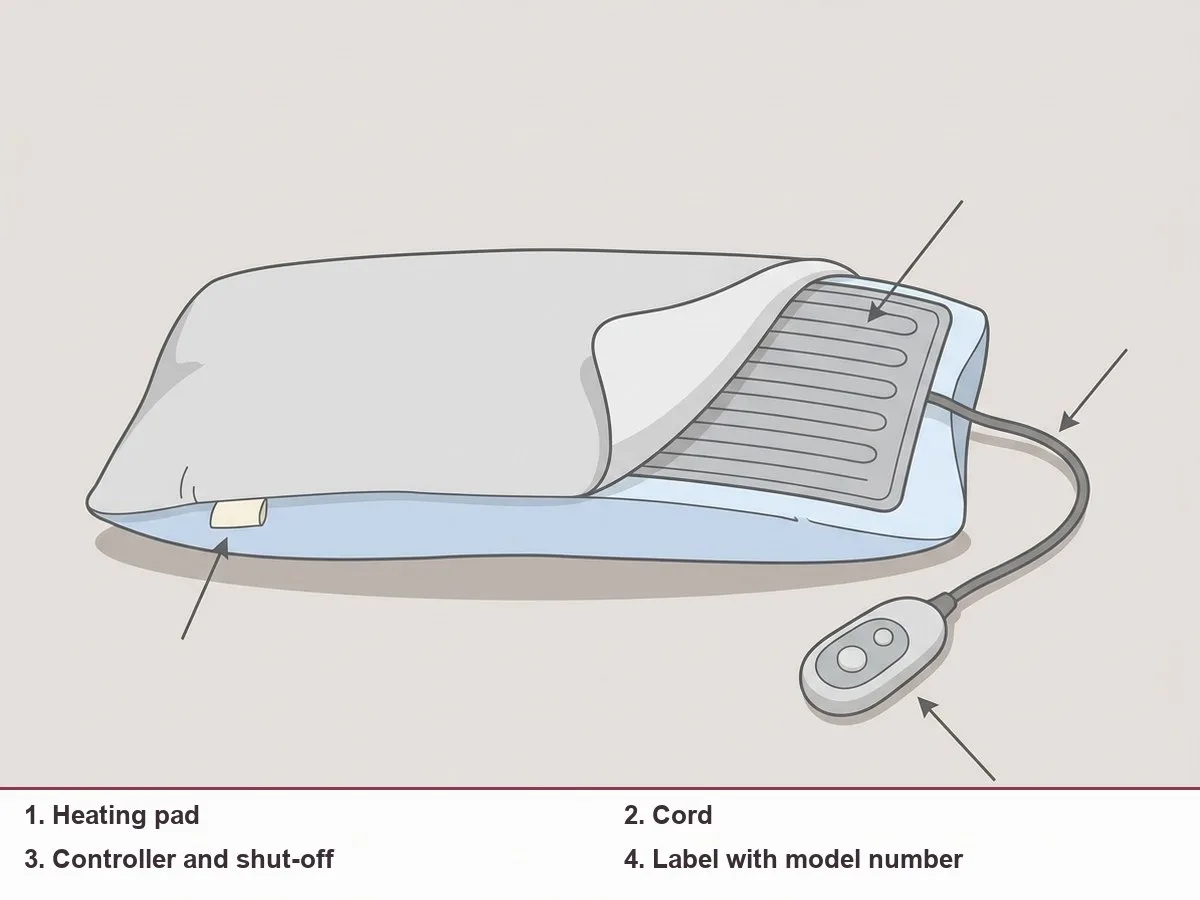
Before you use any electric heated pillow, you should be able to find the maker, the exact model, how the heat is controlled and what the product is meant for, in writing. If you cannot, you cannot check it for recalls or warnings either.
Use this as your label sheet. Fill it in from the box, the tag on the device and the manual:
- Maker and contact: a company name and a way to reach them.
- Model and lot number: printed on the heater or controller itself, not only on the box.
- Safety mark: a mark from an independent testing lab, and the standard it was tested to.
- Heat settings: how many, and what the controller shows.
- Automatic shut-off: whether it has one, and after how long.
- Intended use: where on the body the maker says it is for, and who should not use it.
- Warnings: anything about sleep, skin with reduced feeling, or pregnancy.
- Washing: whether the heater comes out before the cover is washed.
Then look at the device. Check the cord and controller for dark, frayed or melted spots before every use, and replace an old pad rather than nursing it along. One power utility's safety tips note that in almost every heating pad or electric blanket fire they describe, the item was more than ten years old.
If the manual says the product is not for use during sleep, then it is not a sleep pillow while it is switched on, whatever shape it comes in.
Why check for recalls on a heated pillow?
Because heating pads sold online have been the subject of official warnings. In 2022 the FDA told people to stop using one brand of electric heating pad sold through Amazon and Walmart after reports of overheating, sparking and burns.
That one case does not tell you anything about the pillow in your cart. It does show why the model and lot number matter. Without them, you cannot match your device to a warning.
- Search the model number on the CPSC recalls page, and with the word "recall" in a search engine.
- Search the maker's name too, since recalls are often listed by company.
- Keep the manual and a photo of the label with your pregnancy papers, so you can check again later.
Heat itself matters as well. Cleveland Clinic notes that you should not use enough heat to raise your body temperature too high in pregnancy. That is one more reason the setting is a question for your own care team, not for a product page.
Should you sleep with a heated pregnancy pillow switched on?
This guide does not suggest it. A pregnancy pillow is made to be slept against all night, and an electric heater is a device you need to be awake to watch.
Heating pad safety tips, like the utility guidance in our sources, say it in plain words: do not use a pad while sleeping and do not leave it on unattended. When you are asleep you cannot notice skin getting too hot, and a pillow wrapped around you keeps the heat right against your body.
A simple split works for many people. Heat, if your care team says yes, is an awake thing with a timer you can see. Before you lie down for the night, switch it off and unplug it, and sleep on a pillow with no cord at all.
Talia ended up doing exactly that. The heated pillow she ordered went back unopened, because the box gave her nothing to check. What she actually needed was warm feet, and wool socks plus an extra blanket on her side of the bed did that without a plug.
What should you ask your midwife or OB-GYN?
Ask whether heat is right for you at this point in your pregnancy, where on your body it may go, and for how long. Bring the label sheet so they can see the actual device.
- Is using heat OK for me, at my stage of pregnancy?
- Which areas are fine, and which should I keep heat away from? (Many sources handle the back and the bump differently.)
- Which setting, and for how long at a time, for me?
- Do I have anything that changes the answer, such as less feeling in my skin in some areas?
- If heat is not a good idea for me, what else can I try for the reason I wanted it?
Cleveland Clinic covers heating pads on the back in pregnancy and gives a low setting and a short time limit. We are not repeating a number here on purpose, because the right answer depends on your pregnancy, your body and the device in your hand.
When is it not a pillow question at all?
If you wanted heat because of pain, some kinds of pain need a call before any product. Cleveland Clinic lists back pain that is severe, starts suddenly and sharply, or feels like cramping in the hips or abdomen.
It also flags back pain that comes with a fever, painful peeing or vaginal bleeding. Do not try to warm those away. Call your midwife, OB-GYN or labor and delivery unit.
For sleep comfort without heat, our pregnancy sleep guide covers positions, pillows and the symptoms worth raising.
Frequently asked questions
Can I use a heated pregnancy pillow while pregnant?
That depends on the device and on you. Check its label and manual first, then ask your midwife or OB-GYN whether heat is OK for you, where it can go and for how long. This guide does not suggest sleeping with one switched on.
Can I use heat on my belly while pregnant?
Ask your care team before putting heat on your bump. Many sources handle the back and the belly differently, and the answer can change with your stage of pregnancy.
Is a microwavable pillow different from an electric one?
Yes. A microwavable pack has no cord or controller, but it can still get too hot if heated wrong. Follow the maker's instructions exactly, and ask your care team about heat in general.
What should a heated pillow's label include?
At least the maker, the model and lot number on the device itself, a safety mark from a testing lab, the heat settings, any auto shut-off, the intended use and the warnings. Without those you cannot check it for recalls.
Is a pillow sold as warm or cozy a heated pillow?
Usually not. Those words often describe a plush cover. Only a pillow with a cord, battery or controller is an electric heating device.
If what you really want is a regular pregnancy pillow with no cord, our pregnancy pillow buying checklist covers fit, size, washing and return terms.
Talia's story is a composite based on public posts from pregnant people shopping for warmth and comfort. Names and details are changed.