

Relvay makes a pregnancy pillow. We also tell you below when you should not buy one.
The short answer
Judge a pillow by the biggest single piece you must move, how far you reach to move it, and how much grip the cover needs. Weight alone tells you little. Do a lift test at home and pick a spot to set it down first.
- Keep it if you can lift, park and re-cover it alone.
- Rethink it if every sheet change waits for a helper.
- Tell your midwife about new numbness or weak grip.
1:40 a.m., a wet sheet and a pillow I couldn't lift
For a lot of people the pillow works fine for sleeping. The trouble starts the moment it has to leave the bed. This is what that moment can look like.
1:40 a.m.
I knocked my water glass over in the dark. Half of it went straight onto the bottom sheet, right under the big U pillow. I was 31 weeks. Marcus was on a night shift.
Since about 28 weeks my hands had been stiff and tingly in the mornings, and my grip was weaker than usual. My midwife already knew. What I had not planned for was trying to drag a pillow as long as I am tall across a wet bed with fingers that would not close properly.
I got one end onto the floor. The rest slid back. I tried to reach across to the far side and my bump got in the way. In the end I slept on a towel on the dry edge of the bed and cried a little, mostly from being tired of needing help with everything.
- If changing the sheets now means waiting until someone is home...
- If you can sleep with your pillow but cannot get it off the bed...
- If zipping the cover back on takes ten minutes and sore fingers...
- If the pillow lives on the bedroom floor because it is too much to put back...
You are not being weak. Most pregnancy pillows are designed for the hours you lie on them, not the minutes you have to handle them.
"it's not so easy to turn sides what with having to adjust the pillows, lifting your body up to turn, too much work"YouTube comment on a pregnancy sleep video
"I would just get swallowed up in, hard a hard time turning"Amazon review of a pregnancy pillow
What most of us try first
Most people try to muscle the pillow off in one go, then fold it, then leave it somewhere it does not belong. Each workaround costs a little more energy than you have.
- Dragging it by one end.The near end comes with you. The far end stays on the bed, and now you are holding something long and floppy at arm's length.Length beats grip every time.
- Folding it in half to carry.It springs open halfway to the chair. You end up hugging it against your bump to keep it shut.Folding only works if it stays folded.
- Taking the cover off on the bed.The zip runs the full length and needs two hands and a pinch grip. Putting it back on was worse. I did it once and left the old cover on for three weeks.The cover is a second job hiding inside the first.
- Leaving it on the floor.It saved the lifting, until I had to bend down to get it back up at bedtime.You just move the hard part to 11 p.m.
- Waiting for Marcus.He never minded. I minded. Clean sheets became something that happened on his days off.Help is good. Needing it for everything is the loss.

Why is a big pregnancy pillow so hard to move?
Because handling depends on three things at once: the size of the biggest single piece, how far you have to reach across the bed, and how much grip the cover or fasteners need. A pillow can be light and still be hard on all three.
Biggest single pieceA full-length U pillow is one piece, often about 59 to 63 inches long. You can only move it all at once.
ReachThe far side of the pillow is across the bed. With a bump, leaning that far is hard, and kneeling on the mattress is awkward.
GripLong zips, tight covers and small pulls all need pinch strength. An NHS hospital leaflet lists weaker grip for fiddly tasks like zips as one symptom of carpal tunnel syndrome in pregnancy.
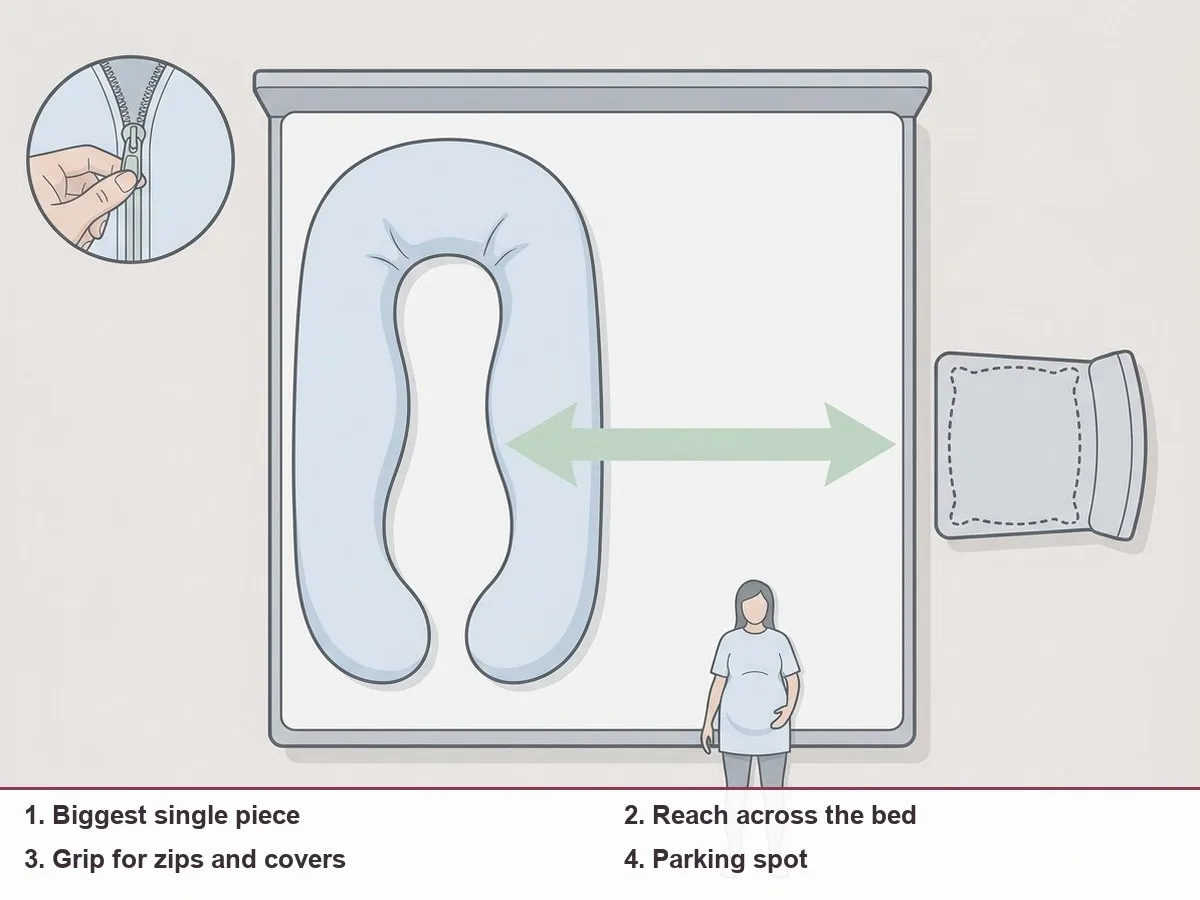
Weight matters too, but splitting a pillow into parts does not always make the total lighter. It changes how much you hold at one time and how far you reach to get it.
The useful question is not how heavy the pillow is. It is: what is the biggest piece I have to hold, and where does it go while the sheet comes off?
That question is what finally made sheet day something Alicia could do alone again. First a test you can run tonight, then what changed.
How can you test whether you can move a pillow yourself?
Run a six-step lift test with the pillow you have, or with a new one inside its return window. Stop at any step that hurts or needs a hard pinch.
- Name the biggest piece. Is it one long pillow, or several parts? Write down the largest.
- Lift it from your side of the bed only. Use open hands and forearms under it, no squeezing. Can you raise it clear of the mattress?
- Turn toward your parking spot. Can you carry it two steps without it dragging, folding open or hitting your bump?
- Do the reach check. Put it in the middle of the bed. Can you bring it to the edge without kneeling on the mattress?
- Do the cover check. Open the zip or fastener, take the cover off, put it back on. Time it. Note any pinch that hurts.
- Put it back. Bedtime is the real test, when you are most tired.
If you passed every step alone, your pillow is fine. If one step failed, that is the step to fix, not the whole setup.
Can you make your current pillow easier to handle without buying anything?
Often, yes. Give the pillow a parking spot, change the sheet in halves, and plan the helper for the hardest step only.
- Make a parking spot at bed height. A cleared chair, a chest or the empty side of the bed means you slide instead of lift.
- Change the bottom sheet one half at a time. Push the pillow to the clean half, do the other side, then swap.
- Keep the pillow on the edge nearest you. Less reach in the morning and at sheet time.
- Add a washable layer. A spare pillowcase or a small towel over the part that gets marked can be changed far more often than a full cover.
- Ask for help with one step. "Can you put the cover back on Sunday?" is easier to ask than "can you do the whole bed?"
Many people find this is enough. If the pillow still needs another person for every change, the setup, not your effort, is the problem.
When is a different pillow setup worth it?
A different setup is worth considering when the free fixes still leave you waiting for help just to keep your bed clean. Tick what sounds like your week:
- I can sleep with my pillow but cannot lift it off the bed alone.
- The cover stays dirty because putting it back on is too hard.
- The pillow ends up on the floor and I struggle to get it back.
- I have to reach across the whole bed to move it.
- Sheet changes now happen only when someone else is home.
Two or more? A setup with smaller parts you handle one at a time may suit you better. Test it with the six steps above before you rely on it.
New or worsening numbness, tingling or weakness in your hands or arms is something to tell your midwife or doctor about. A pillow is a comfort aid. It does not change what is causing that.
Which pillow types are easiest to handle?
Smaller pieces mean less to hold at once and less reach, but more parts to place. Here is how common types compare on handling, not on comfort.
| U pillow | C or J pillow | Single wedge | Two wedges strapped together | |
|---|---|---|---|---|
| Biggest piece you hold | Whole pillow, often 59 to 63 in long | Whole pillow | One small piece | One small wedge at a time |
| Reach to clear the bed | Across the whole bed | Most of your half | Very little | About your torso width |
| Cover to change | One long cover | One long cover | One small cover | Check how covers and strap come off |
| Parking space needed | Floor or a second bed | A large chair | Any shelf | A chair seat |
| Parts to place at bedtime | One | One | One, covers one area | Two plus a strap |
Before you order any model, look for the dimensions of each part and how the cover and any strap open. If a listing does not say, ask, and keep the return window in mind.
What changed when the pieces got smaller?
When no single piece was bigger than a cushion, Alicia could clear the bed in two easy moves and do the sheet herself.
Alicia kept a long regular pillow between her knees and switched to two small wedges joined by a strap for her bump and back. She ran the lift test the first afternoon. One wedge to the chair, the other wedge after it, strap folded on top.
The next Saturday she changed the whole bed before Marcus woke up. It took her ten minutes and she was proud of it in a way that surprised her. Her hands were still stiff some mornings, and she still told her midwife about it. The bed just stopped being one more thing she could not do.

Frequently asked questions
What is the easiest pregnancy pillow to move around?
Usually the one with the smallest single piece and a cover you can open without a hard pinch. Run a lift test: lift each piece from your side of the bed, carry it two steps and change the cover.
Are pillows that come in parts lighter?
Not always. Parts can add up to a similar total. They help because you hold one smaller piece at a time and reach less, not because the whole set weighs less.
How do I change the sheets with a big pregnancy pillow on the bed?
Push the pillow to one half, change that half of the bottom sheet, then swap. Keep a chair or chest at bed height nearby so you can slide pieces instead of lifting them.
My hands feel numb and weak in pregnancy. Should I worry?
Tingling, numbness and a weaker grip are common in pregnancy, but tell your midwife or doctor, especially if it is getting worse. They can check it and suggest what helps.
Should someone else always handle my pillow?
Only if you want them to. A parking spot, half-sheet changes and asking for help with one step often give you back most of the job.
Where the Relvay 3-Piece pillow fits in
The Relvay 3-Piece is the two-wedge set from Alicia's story. Its largest piece is one small wedge, so you never have to hold a full-length pillow. We have not published a weight for the set, so we will not tell you it is light. Run the lift test on it in your first week.

1. The bump wedgeA crescent-shaped wedge that tucks under your bump, thin edge toward your belly button, so the weight is not pulling on your back.
2. The back wedgeThe same shape, snug against your lower back so it has something to rest against.
3. The strap and small cushionA flat strap runs under you and joins the two wedges, so they stay together instead of drifting apart. A small oval cushion sits on the strap between them. You can set the distance as the bump grows.
Each wedge is about 17 by 13 inches and about 4 inches thick at its outer edge, tapering thinner toward your body (supplier measurement). Opened out, the set is roughly as wide as your torso, so it stays on your half of the bed and you keep your normal head pillow. Soft ribbed pink fabric on top, white sides. It is small enough to pack for a trip.

What it does not do: it does not go between your knees. Keep a regular pillow there, the way the NHS suggests. That combination covers all three points without a giant pillow.
Probably not for you if
- Your current pillow already passes the lift test.
- You need one pillow that also holds your knees and head.
- Opening a strap or cover by hand is not possible for you right now.
Made for you if
- A full-length pillow is the part you cannot lift.
- You want to change the sheets on your own.
- You have a chair or shelf nearby to park two small wedges.
Try it for 90 nights
Sleep on it through the weeks that matter. If it is not right for you, email us within 90 days of delivery and send it back for a refund. Return shipping is on you unless it arrived faulty.
$79.99
90-day money-back guarantee · Free US shipping over $70 · 3 pieces, one set
Check price and availabilityAlicia's story is a composite based on real reviews and public posts from pregnant side sleepers. Names and details are changed.