

Relvay makes a pregnancy pillow. We also tell you below when you should not buy one.
The short answer
A head section usually feels too high because of what is under it. Remove your own pillow first, then check the pillow's orientation and the body section.
- First: no extra pillow on top of the head section.
- Then: slide down so your shoulder is on the mattress.
- Still high? Lower the body section, then use the adjustment your model allows.
Try these five checks first
Most head sections feel too high because something is stacked under them or the pillow is the wrong way round. Work down this list one change at a time, one night each.
- Take your own pillow out. If your pregnancy pillow has a head section, it is usually meant to replace your head pillow, not sit on top of it.
- Check which end is the head end. Some U pillows have one end meant for your head and one for your feet. Your model's instructions or product photos show which.
- Move yourself, not the pillow. Slide down a few inches so your bottom shoulder rests on the mattress, not on the edge of the head section.
- Look at the body section. If the part under your bump or chest is lifting your upper body, your head will feel high even when the head section is fine. See the next section.
- Use the adjustment your model allows. Some pillows let you remove filling, unzip a section or detach a piece. Only do what the instructions describe.
5:52 a.m.
Emma woke before the alarm again with her neck locked to one side. She was 31 weeks and had a new J pillow, and she had been sleeping with its hook under her head and her favourite thick pillow on top, "for extra comfort". Her partner Theo took one photo of her lying on her side. Her head was tipped up like she was reading the ceiling. One pillow less, and the next morning she could turn her head to see the clock.
"The neck is too high always waking up with neck pain."Amazon review of an F-shaped pregnancy pillow
How do you tell which layer is too high?
Count the layers under your head and under your shoulder. Your head should sit about level with your spine when you lie on your side, so the problem is whichever layer adds height without a reason.
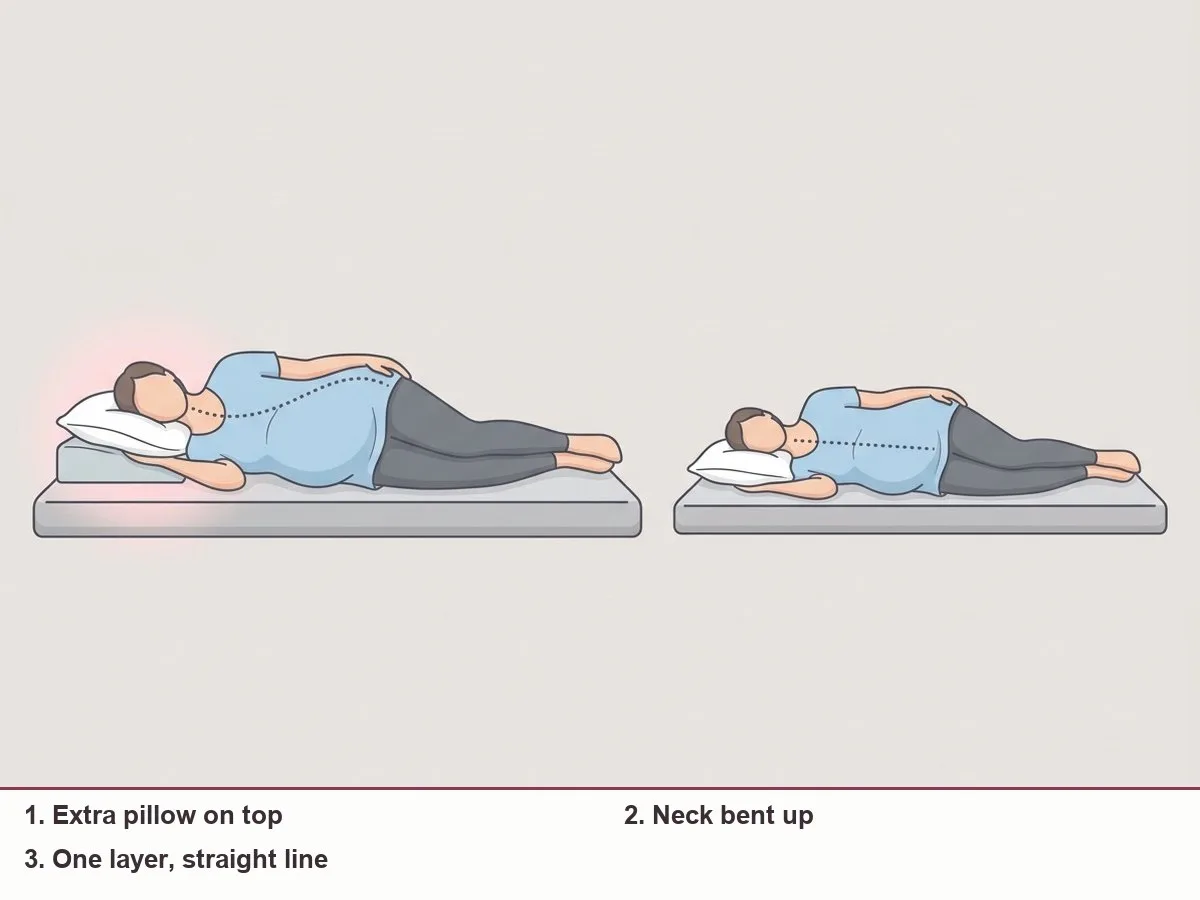
| Layer | How to check it | If it is the problem |
|---|---|---|
| Your own head pillow | Is it under the head section? | Remove it for a night. |
| The head section itself | Lie on it alone. Is your head still tipped up? | Check orientation, then any filling or detach option in the instructions. |
| Your shoulder position | Is your bottom shoulder on the pillow edge? | Slide down so the shoulder rests on the mattress. |
| The body section | Is your chest or bump propped higher than your hips? | Move the body section lower or flatter, as below. |
| A mattress topper | Is it new, or soft only under your hips? | A sinking hip can make the head feel high by comparison. |
The easiest way to see it is a photo from behind or the side while you lie there. A straight line from your head down your back is what you are after.
Is it the head section or the body section?
If your head feels high only when your bump or chest is on the pillow, the body section is the cause. It lifts your whole upper body, and the head goes with it.
Try this: lie on your side with your head on the head section but your bump off the pillow. If your neck feels fine, the head part is not too high. The section under your front is too thick or too far up. Shift the pillow down so the thick part sits under the bump itself, not under your ribs or chest.
A head that feels too high is often a body that is propped too high. Fix the lower layer before you cut the top one.
Which layout can you try with your shape?
Each shape has one or two layouts that lower the head without fighting the design. Try only what your model's instructions allow.
| Shape | Try | Keep in mind |
|---|---|---|
| U | Swap which end is at your head, if the ends differ. Slide down so the curve meets your neck, not your cheek. | Some U pillows are thicker at one end on purpose. |
| C | Rest your head on the curve with no extra pillow, or set the curve lower behind your neck. | The long arm should still reach between your knees. |
| J or L | Lower the hook to neck level instead of under the whole head. | When you switch sides, the hook may need to move too. |
| Wedge or strapped wedges | These have no head section. Use your normal pillow at its usual height. | If your head still feels high, check the wedge under your front is not too far up. |
Neck pain that lasts, or comes with numbness, tingling or headaches, is something to raise with your midwife or doctor. Pillow changes are for comfort, not a treatment.
Frequently asked questions
Should I use my own pillow with a pregnancy pillow?
Not if your pregnancy pillow has a head section. It is usually meant to replace your head pillow. With wedges or strapped sets, which have no head section, keep your normal pillow.
Why does my pregnancy pillow hurt my neck?
Often because the head is propped too high: an extra pillow on top, the pillow the wrong way round, or a thick body section lifting your upper body. Check those before buying anything new.
Can I take filling out of my pregnancy pillow?
Only if the instructions say the filling is adjustable and show how. Some pillows have a zip for this, others are sealed and should not be opened.
How high should my head be when side sleeping in pregnancy?
About level with your spine, so your neck is not bent up or down. A photo from behind while you lie on your side shows it quickly.
If you would rather choose your own head height
Some people simply prefer a pillow setup with no head section at all, so their usual head pillow stays in charge. The Relvay 3-Piece is built that way: it supports the bump and the back, and your head stays on whatever pillow already suits you.

Two wedges for bump and back, joined by a flat strap, about as wide as your torso. Keep a regular pillow between your knees. $79.99, 90-day returns.
Emma's story is a composite based on real reviews and public posts from pregnant side sleepers. Names and details are changed.