

Relvay makes a pregnancy pillow. We also tell you below when you should not buy one.
The short answer
The right size is the one that reaches your support points. Measure your height, how wide you are lying on your side and your bump, then compare them with the pillow's length and inner space.
- Length: should run from your shoulders to your ankles, not past your head.
- Inner space: wider than you are on your side.
- Bump: re-check in the third trimester.
4:20 a.m., and a pillow taller than me
Most pregnancy pillows are sold in one size, built around an average body. If you are shorter, taller or bigger than that average, the support lands in the wrong places. This is what that feels like.
4:20 a.m.
I am five foot two. That is 62 inches. The U pillow I ordered at 31 weeks was 65 inches long. I did not do that math until I was lying in it.
The top curve pushed my head up so my neck bent like I was reading in bed. The part meant for my knees ended up around my calves. And the middle, where my bump should have rested, was a dip I sank into. I woke up at 4:20 with a stiff neck and one numb arm, and Dev asked, half asleep, why I was building a fort of towels inside a pillow that cost us more than our sheets.
I remember thinking that every review said this pillow was life-changing. Just not for someone my size.
- If the head end of your pillow is always too high...
- If the knee part lands on your calves, or nowhere at all...
- If you feel squeezed inside a U, or lost in it...
- If you keep adding regular pillows on top of the pregnancy pillow...
You are not shaped wrong. Most pillows are sized for one body, and the size chart never asks about yours.
"The neck is too high always waking up with neck pain."Amazon review of a pregnancy pillow
"As someone who is plus-size, I found it difficult to position the pillow comfortably, and it didn't stay where I needed it throughout the night."Amazon review of a pregnancy pillow
What we try when the size is wrong
Most people try to pad, stack or swap their way around a size problem. It helps for a night and then the same spots go wrong again.
- Towels to fill the gaps.A rolled towel under my bump, another under my neck. By morning they had unrolled and I was back in the dip.Patches move. The size stays wrong.
- Stacking pillows on top.I added two regular pillows above the U so my head would sit level. Now the U was doing nothing but taking space. "Yeah I had to layer like three more pillows on top of the pregnancy pillow just to get comfortable." (YouTube comment) · Paying for a pillow and then sleeping around it.
- A single small wedge instead.Easy to place exactly under my bump. But by 34 weeks it felt too small to hold it, and it did nothing for my back. "The half pillow by itself is a little too small to be effective on my 9 month bellow." (Amazon review) · Right place, not enough of it.
- My sister's pillow.She is five foot ten and swore by it. On me the same pillow was a different pillow. I gave it back after two nights and a sore hip.Reviews come from bodies that are not yours.

Why does a one-size pregnancy pillow fit some bodies and not others?
Because a full-body pillow has its support built into fixed places. Your height decides where the head and knee parts land, your side-lying width decides whether you fit inside, and your bump keeps changing all the way to the end.
Your heightSets where the head end and the knee part fall along your body.
Your side-lying widthFront of bump to back of spine. It has to fit inside the pillow's inner space.
Your bumpIts size and height off the mattress grow every few weeks.
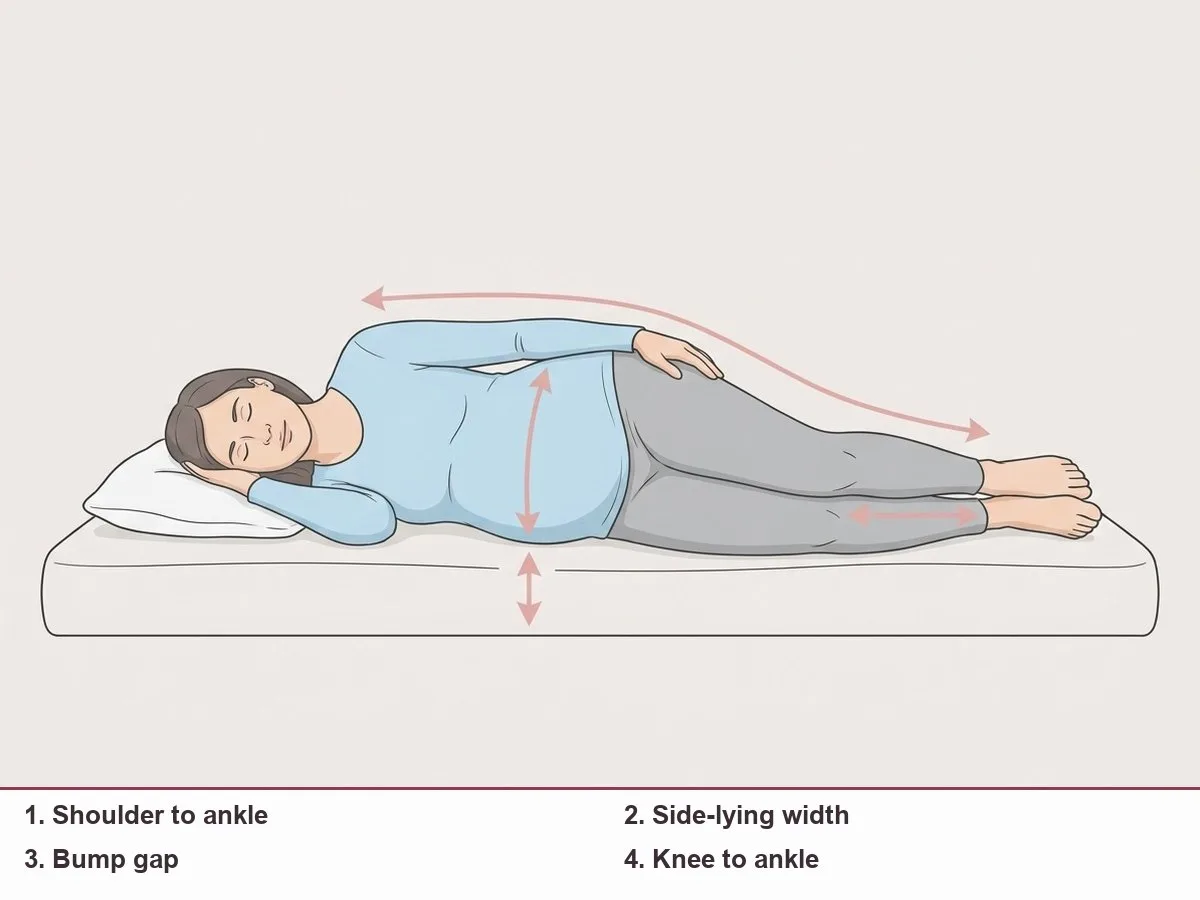
The bump adds a moving target. A pillow that fit well at 24 weeks can miss by a few inches at 34, even if your height never changes and nothing else does.
A U-shaped pillow is commonly 55 to 65 inches long. A woman at 5 foot 2 and a woman at 5 foot 11 are 62 and 71 inches tall, so the same pillow sits nine inches differently on them. That is a whole support point, landing somewhere it was never meant to be.
A pregnancy pillow does not need to match your size label. It needs to put support exactly where your body needs it, at your height, this month.
That is something you can measure in ten minutes. Below is the worksheet, what to do if you are tall, petite or plus-size, and the layout that finally fit Abby's 62 inches.
How do you measure your body for a pregnancy pillow?
Lie on your side the way you sleep and have someone measure four points. Then compare each one with the pillow's listed size before you order.
| Body point | How to measure | Compare with |
|---|---|---|
| 1. Shoulder to ankle | Top of shoulder to ankle bone, knees bent as you sleep | Usable length of a full-body pillow, below the head curve |
| 2. Side-lying width | Front of bump to back of spine, at the widest point | Inner space between the two arms of a U or C |
| 3. Bump gap | Lowest point of your bump to the mattress | Thickness of whatever goes under your bump |
| 4. Knee to ankle | Inside of knee to inside of ankle | Length of the pillow part between your legs |
Write your four numbers next to the four listing numbers. If the listing does not give inner space or thickness, ask the seller before you buy. A pillow that cannot tell you its inner space cannot tell you whether you fit in it.
What size pregnancy pillow for tall, petite or plus-size bodies?
Tall bodies need length, petite bodies need a lower head end and shorter reach, and plus-size bodies need inner space and a thicker bump support. Each one changes a different number on the worksheet.
Tall (about 5 foot 9 and up). Check that the usable length reaches your ankles, not just your knees. A pillow that stops short leaves your top leg dropping toward the mattress. Long straight pillows and pieces you place yourself work at any height.
Petite (about 5 foot 3 and under). Check how high the head curve is and how far the knee part sits from it. If the head end lifts your neck, use your own flat head pillow and let the pregnancy pillow start below your shoulders.
Plus-size. Your side-lying width is the number that matters most. If it is close to the inner space of a U or C, you will feel squeezed and the pillow will shift. Separate pieces you place against your body have no inner space limit, but check that the bump support is wide and thick enough for your bump.
For bed width, which is a different measurement, see pregnancy pillow for a small bed.
Can you size regular pillows to your body for free?
Yes, and it is the best way to learn your own support points. Loose pillows have no fixed size, so they fit any height.
- Keep your normal head pillow so your neck stays level with your spine.
- Fold a pillow under your bump until it fills the gap you measured, no higher.
- Place a firm pillow between your knees and ankles, long enough to cover both.
- Push a pillow behind your lower back, tight against the mattress.
- Mark where each one sits. Those are the places any pillow you buy must reach.
The NHS suggests this kind of pillow support for side sleeping. If the setup fits and stays, keep it. If it falls apart when you turn, you now know what size of support to look for.
When is a different size or type worth buying?
It is worth it when your current pillow keeps missing the same body points night after night. Tick what sounds familiar:
- I wake up with a sore neck from the head end.
- The knee part does not reach between my knees.
- I feel squeezed inside the pillow, or I sink into a gap.
- I add regular pillows on top every night.
- My bump has outgrown the support under it.
Two or more? The size is wrong for your body, and padding will not fix it. Many people notice this in the third trimester, when the bump grows fastest.
Neck, hip, pelvic or back pain that keeps coming back is worth raising with your midwife, OB-GYN or a pelvic health physical therapist. A pillow is a comfort aid, not a treatment.
Which pregnancy pillow types adjust to your body size?
Pillows with fixed shapes fit best near the average body. Pieces you place yourself fit more bodies, because you decide where they go.
| U pillow | C pillow | Long straight pillow | Single wedge | Two wedges strapped together | |
|---|---|---|---|---|---|
| Height matters | A lot | A lot | Some | No | Little |
| Inner space limit | Yes | Yes | No | No | No |
| Grows with the bump | No | No | No | Swap for bigger | Move the pieces |
| Between the knees | Yes | Yes | Yes | No | Add a regular pillow |
What changed when the support matched her body?
Once the pieces sat at her own support points, the neck pain and the towels went away, and so did the nightly rebuild.
Abby did the worksheet on the living room floor with Dev and a sewing tape. Shoulder to ankle: 44 inches. Bump gap: about three fingers. Side-lying width: more than she expected. None of it matched the 65-inch U.
She went back to her own flat head pillow, a regular pillow between her knees, and two small wedges joined by a strap: one in her bump gap, one behind her lower back. The first morning she woke up and turned her head without wincing. A week later Dev found the towels folded back in the closet and laughed that she had finally evicted the fort.

Frequently asked questions
What size pregnancy pillow should I get?
One whose usable length runs from your shoulders to your ankles, whose inner space is wider than you are lying on your side, and whose bump support fills the gap under your bump. Measure those first.
How long is a full-body pregnancy pillow?
Common U-shaped pillows are about 55 to 65 inches long and 28 to 38 inches wide. Straight body pillows are often 48 to 54 inches. Check the usable length below the head curve, not just the total.
Is a pregnancy pillow too big for a short person?
It can be. If the pillow is as long as you are tall, the head end lifts your neck and the knee part lands too low. Use your own flat head pillow, or choose pieces you place yourself.
What pregnancy pillow works for plus-size bodies?
Look first at inner space. If your side-lying width is close to it, a U or C will feel tight and shift. Separate pieces placed against your body have no inner limit; check the bump support is big enough.
Do I need a bigger pregnancy pillow as my bump grows?
You may need more support under the bump, not a longer pillow. Re-measure the gap under your bump in the third trimester. Pieces you can move or swap keep up more easily than a fixed shape.
Where the Relvay 3-Piece pillow fits in
The Relvay 3-Piece is the strapped two-wedge layout Abby ended up with. It has no head curve and no inner space, so it is placed at your bump and back rather than sized to your height. It is still one size, so check its numbers against your worksheet.
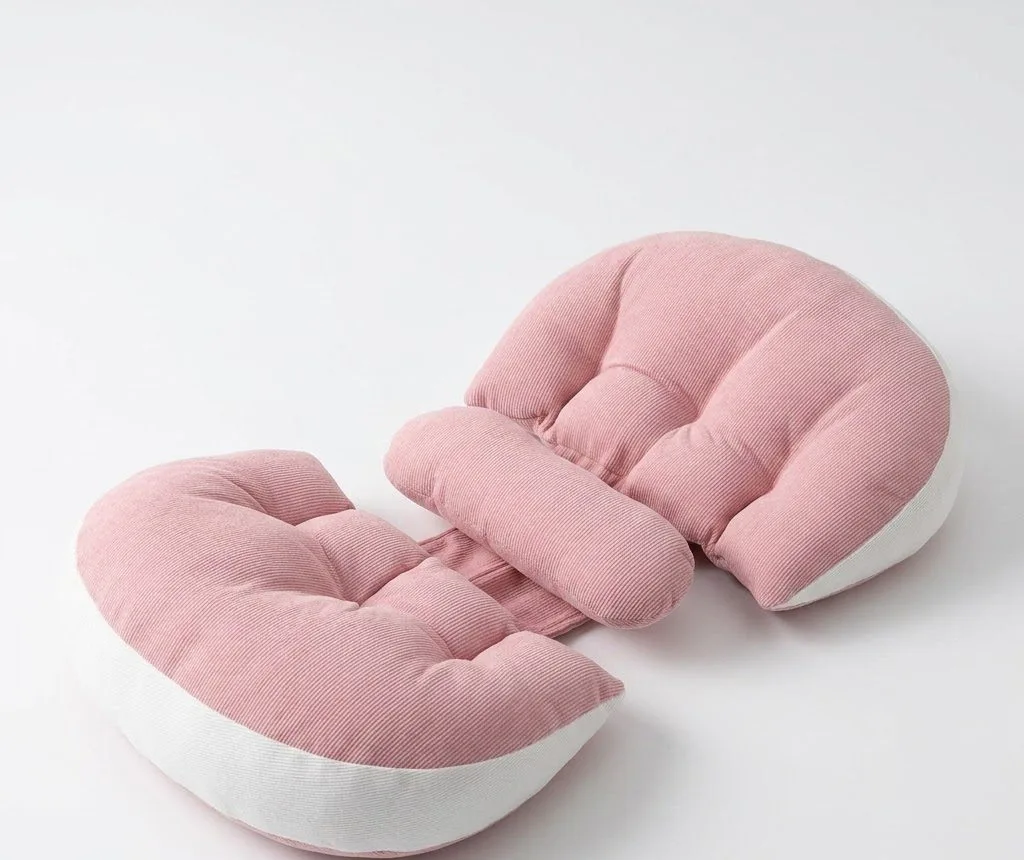
1. The bump wedgeA crescent-shaped wedge that tucks under your bump, thin edge toward your belly button, so the weight is not pulling on your back.
2. The back wedgeThe same shape, snug against your lower back so it has something to rest against.
3. The strap and small cushionA flat strap runs under you and joins the two wedges, so they stay together instead of drifting apart. A small oval cushion sits on the strap between them. You can set the distance as the bump grows.
Each wedge is about 17 by 13 inches and about 4 inches thick at its outer edge, tapering thinner toward your body (supplier measurement). Opened out, the set is roughly as wide as your torso, so it stays on your half of the bed and you keep your normal head pillow. Soft ribbed pink fabric on top, white sides. It is small enough to pack for a trip.
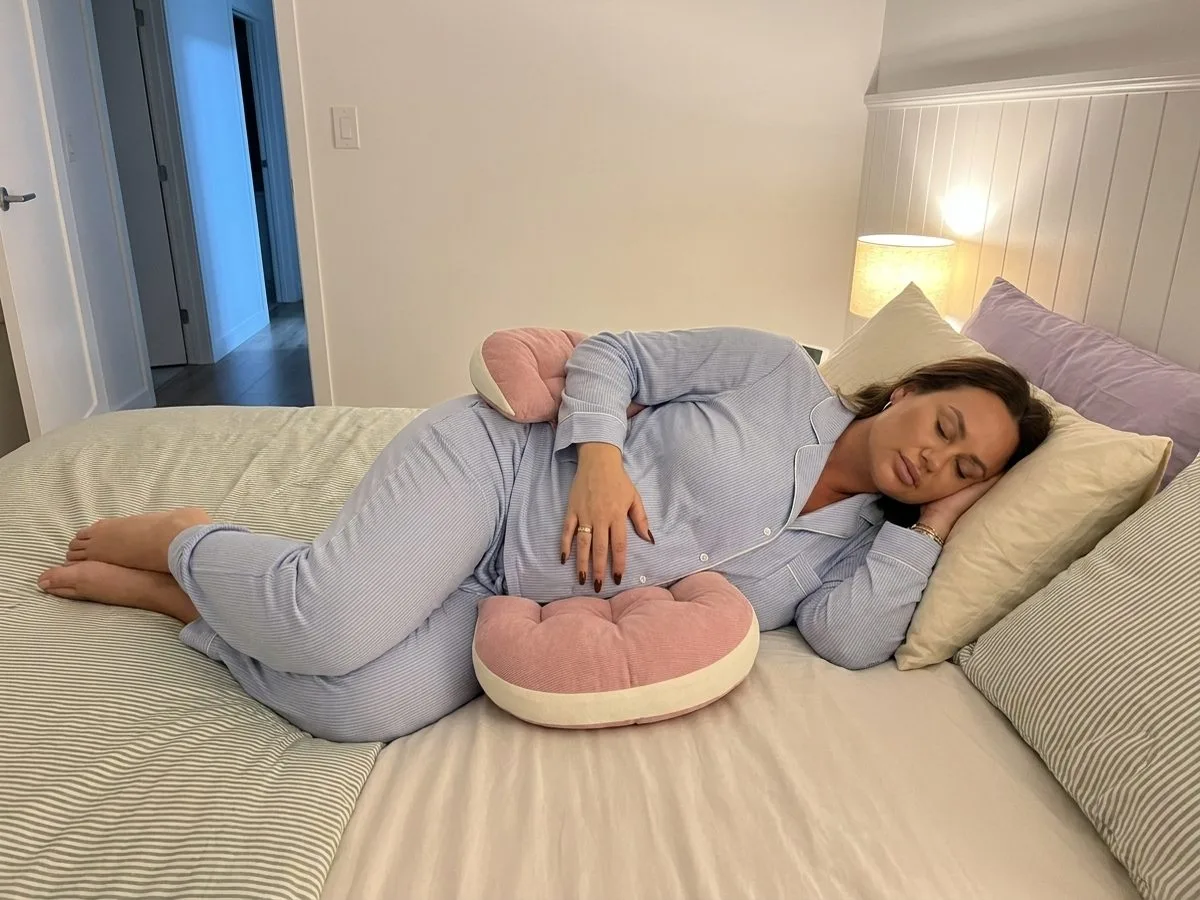
What it does not do: it does not go between your knees. Keep a regular pillow there, the way the NHS suggests. That combination covers all three points without a giant pillow.
Probably not for you if
- You want one pillow that runs from your head to your ankles.
- Your bump gap is much bigger than a 4-inch-thick wedge can fill. We have not tried it on every body.
- A fixed U or C already fits your height and width.
- Your main problem is pain that needs a doctor's advice first.
Made for you if
- Full-body pillows land in the wrong places on you.
- You want bump and back support placed at your own points.
- You are happy to keep your own head pillow and a pillow between your knees.
Try it for 90 nights
Sleep on it through the weeks that matter. If it is not right for you, email us within 90 days of delivery and send it back for a refund. Return shipping is on you unless it arrived faulty.
$79.99
90-day money-back guarantee · Free US shipping over $70 · 3 pieces, one set
Check price and availabilityAbby's story is a composite based on real reviews and public posts from pregnant side sleepers. Names and details are changed.