
Relvay makes a pregnancy pillow. We also tell you below when you should not buy one.
The short answer
Do not place a pregnancy pillow in or against a bed rail or transfer aid setup by guesswork. The FDA says rails, mattress and frame must be compatible, and soft layers can create gaps when they compress. Ask whoever set up or supplies the equipment to review the pillow first.
- Map it: pillow, equipment, helper's path.
- Bring the manuals and the pillow's sizes.
- Recheck after any change to bed or pillow.
Why does a pillow change a bed rail or transfer aid setup?
Because rails and transfer aids are fitted to a specific bed, mattress and way of moving. A pillow adds something soft that compresses, shifts and takes up space the equipment was planned around.
The FDA's advice to consumers and caregivers on adult portable bed rails asks you to confirm that the rail, mattress and bed frame are compatible, to install rails following the manufacturer's instructions, and to inspect regularly for gaps. It warns that soft mattresses, mattress pads and air mattresses can create gaps through movement or compression, and that rails can shift or loosen over time.
The FDA page does not talk about pillows. That is exactly why this is not something to work out alone. A pregnancy pillow changes the soft layers on the bed, and only someone who knows your equipment can say what that means for your setup.
The question is not where the pillow fits. It is whether the equipment still works the way it was set up once the pillow is there.
What does this look like in a real bedroom?
Usually it starts with a sensible idea: push the pillow up against the rail so it stays put. That is the moment to stop and ask.
9:40 p.m.
I was 30 weeks. I had a grab rail on my side of the bed, fitted by an occupational therapist long before I was pregnant. When the pregnancy pillow arrived, my first thought was to tuck it against the rail. It would stay in place, I thought, and I would have something to hold.
Sam asked, "Bridget, did anyone say we could do that?" Nobody had. So I took photos instead, wrote down the rail model and emailed my OT. She came out the next week and moved the pillow to a different spot than I would have picked.
"it's not so easy to turn sides what with having to adjust the pillows, lifting your body up to turn, too much work"YouTube comment on a pregnancy sleep video
Asking first is not overcautious. It is the same check the equipment needed when it was installed.
What should your equipment review sheet include?
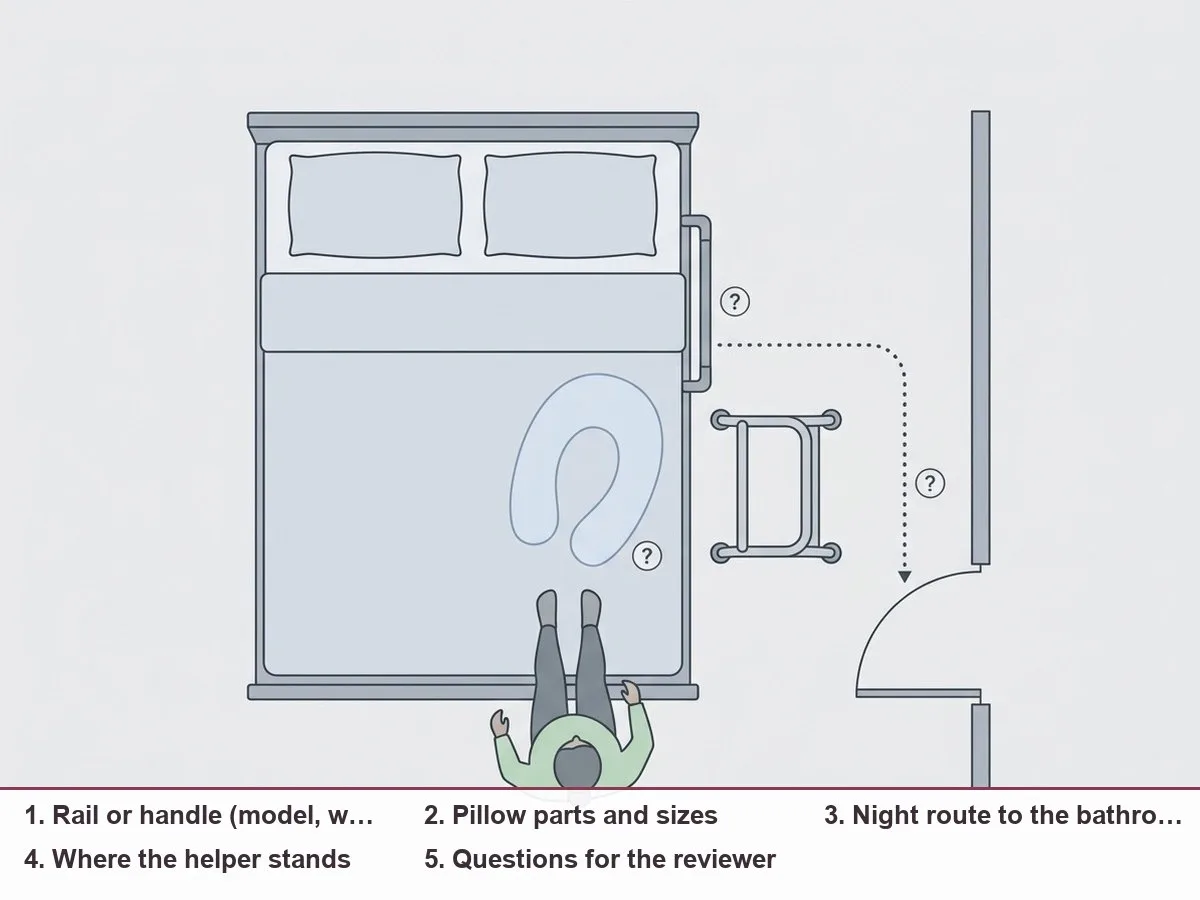
One page with a sketch and a few facts: the equipment, the pillow, where each sits, and how you and any helper move around them. The reviewer decides the layout. You just make it easy to check.
- Sketch the bed from above. Mark the rail, handle or transfer aid, which side you get in and out, and where a helper stands.
- List the equipment. Make, model and who fitted or supplied it. Find the manual or the maker's website.
- Describe the pillow. Type, number of parts, size of each part from the label or listing, and any straps or loose pieces.
- Mark the night route. How you get up to pee, which way you turn, where a transfer aid parks overnight.
- Note what changes. New mattress, topper or mattress pad, bed height, a growing bump.
- Write your questions. For example: "Can a pillow sit on this side at all?" and "What should we recheck, and how often?"
Take photos of the bed as it is now, without the new pillow. That gives the reviewer the starting point.
Who should check a pillow next to bed equipment?
Whoever set up or supplies the equipment: an occupational therapist, physiotherapist, the equipment supplier or the rail or bed manufacturer. If a care facility or hospital provided it, ask them.
The FDA says that if you are unsure about a rail, you can call the manufacturer. Rails that are not intended for a medical purpose are consumer products under the U.S. Consumer Product Safety Commission. Either way, the maker's instructions apply to your setup, and they are written for the rail, not for the pillow you add.
Tell your midwife or doctor too. If getting in and out of bed or turning over is getting harder, that is worth their attention on its own. The NHS suggests contacting your midwife or GP if it hurts to turn over in bed, and they can refer you to a physiotherapist who works with pregnancy pelvic problems.
What should you avoid while you wait for a review?
Keep the setup that was last checked, and keep the new pillow away from the equipment until someone has looked at it.
- Do not push pillows, towels or cushions between the mattress and a rail.
- Do not tie or strap a pillow to a rail, handle or transfer aid.
- Do not change how a helper moves you to make room for a pillow.
- Do not remove or loosen any safety strap or fixing that came with the rail.
- Do not rely on a pillow to stop you from moving toward the edge.
If the wait is long, ask the reviewer what is fine to use meanwhile. Many people simply use regular pillows away from the equipment for a few nights.
Frequently asked questions
Can I use a pregnancy pillow with a bed rail?
Possibly, but do not decide the layout yourself. The FDA says rail, mattress and frame must be compatible and soft layers can create gaps. Ask whoever fitted or supplies the rail to check the setup with the pillow.
Is it okay to wedge a pillow between the mattress and the rail?
Do not do this. It changes the soft layers the rail was fitted against. Keep pillows away from the rail until the equipment's supplier, manufacturer or your therapist has reviewed it.
Who checks bed rails at home?
Usually the occupational therapist or supplier who set them up, or the manufacturer. If a care facility provided the equipment, ask them. Your midwife or doctor can help you get a referral.
Does a new mattress topper change my bed rail setup?
It can. The FDA warns that mattress pads and soft mattresses can create gaps through compression. Tell whoever checks your equipment about any new topper, pad or mattress.
Getting out of bed is getting harder in pregnancy. What should I do?
Tell your midwife or GP. The NHS suggests contacting them if it hurts to turn over in bed, and they can refer you to a physiotherapist who works with pregnancy pelvic problems.
Once the equipment is checked and you are choosing a pillow, our pregnancy pillow buying checklist helps you note sizes and parts for the reviewer.
Bridget's story is a composite based on public posts from pregnant people about sleep. Names and details are changed.