
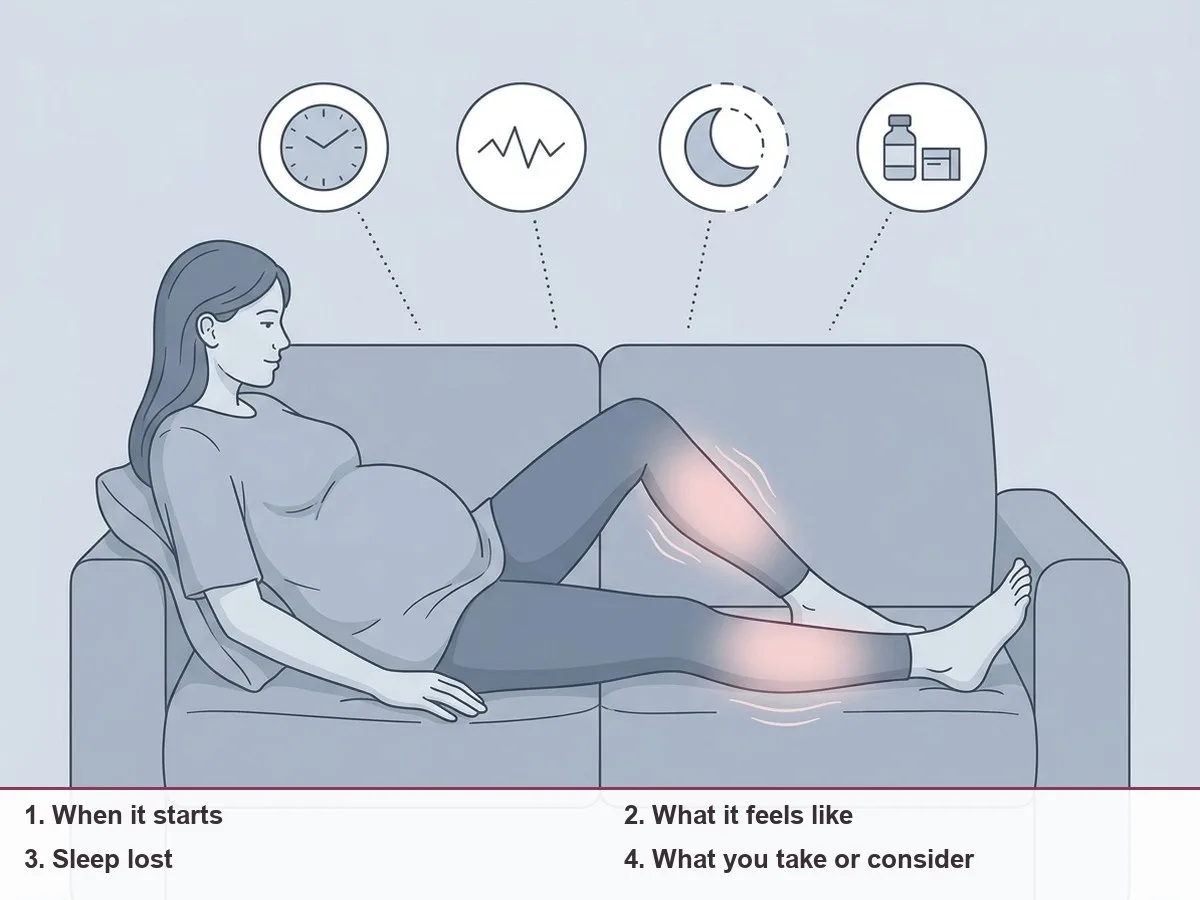
Relvay makes a pregnancy pillow. We also tell you below when you should not buy one.
The short answer
Restless legs are common in pregnancy, usually worst at night and in the last trimester, and they often ease after birth. Before buying supplements or gadgets, log your symptoms for one to two weeks and take the log to your midwife or doctor.
- Log: feeling, timing, sleep lost.
- Ask: whether your iron should be checked.
- Do not start supplements or medicines without asking.
What do restless legs feel like in pregnancy?
It is a strong urge to move your legs, often with tingling, throbbing or itching, that gets worse when you rest in the evening or at night. The NHS lists pregnancy as one possible cause and says symptoms usually go away after giving birth.
MotherToBaby puts it at roughly 10 to 34 percent of pregnant women, and notes it tends to be most intense in the last three months. So it is common. It can still wreck your nights.
10:55 p.m.
I was 33 weeks. Every night it started the same way: I would finally lie down, and within ten minutes my calves felt like they had something crawling under the skin. Moving them helped for a second. Then it came back.
Theo would ask if I was okay and I would say "just my legs" and get up and walk to the kitchen and back. By midnight I had three tabs open: magnesium, iron, some leg cream with five-star reviews. I was ready to buy all of them.
"Toss and turn all night until I just finally fall asleep"YouTube comment on a pregnancy sleep video
Wanting to fix it fast is normal. But what you order tonight is a guess. What you write down tonight is evidence.
Is it restless legs, a cramp, or something else?
Only your midwife or doctor can tell you. Leg cramps and sudden jerks as you fall asleep can feel similar, and MotherToBaby says these need to be ruled out. Your notes help them do that.
| What you notice | Often described as | What to do |
|---|---|---|
| An urge to move, crawling or tingling, eased by moving, worse at rest | Typical restless legs description | Log it and bring it to your next appointment |
| A sudden hard, painful knot in the calf or foot | Typical cramp description | Log it separately, it is a different question |
| One sudden jerk as you drift off | Typical sleep-start jerk description | Note it, mention it if it keeps waking you |
| One leg painful, swollen, warm or red | Not something to log and wait on | Contact your midwife, doctor or maternity unit now |
This table is to help you describe what happens. It is not a way to diagnose yourself.
What should you put in your symptom log?
Each night, note when the feeling started, what it felt like, what you did, and how much sleep it cost. One line per night, for one to two weeks, is enough.
| Night | Started | Felt like | Where | What eased it | Sleep lost |
|---|---|---|---|---|---|
| Mon | 10:50 p.m., lying down | Crawling, urge to move | Both calves | Walking, stretching | About 1 hour |
| Tue | 9:30 p.m., on the couch | Tingling | Left calf, then both | Warm shower | About 30 min |
| Wed | None | None |
- Use your own words. "Fizzy", "crawling", "like I need to kick" are all useful.
- Note the setting. Lying in bed, sitting on the couch, a long car ride.
- Add the day. Caffeine after midday, a late big meal, a very active or very still day.
- Count the cost. Rough minutes of sleep lost, and how you felt the next morning.
What should you list about supplements and products you are considering?
List everything you take now and everything you are thinking of buying, with one question next to each. Bring the list instead of starting anything new on your own.
| Item | Taking now or considering? | My question |
|---|---|---|
| Prenatal vitamin | Taking | Does it already contain iron or folic acid? Is that enough? |
| Iron tablets | Considering | Should my iron be checked first? |
| Magnesium | Considering | Is this worth trying for me, and in what form? |
| Allergy or sleep tablets | Taking sometimes | Could these make my legs worse? |
| Compression socks, leg cream, a pillow | Considering | Anything I should avoid? |
The NHS says a doctor may review your medicines, because some can make restless legs worse, and that treating low iron can help when it is the cause. MotherToBaby notes that iron supplements may be used if a deficiency is found, and that some women improve with them while others do not. That is why the check comes first.
Nadia closed the three tabs. She wrote the magnesium, the iron and the leg cream on the list instead, under her prenatal vitamin, and put the list in her bag for her 34-week appointment.
Which questions should you bring to your appointment?
Bring four or five short questions and your log. Start with the one that matters most to you, in case time runs short.
- Does what I have written sound like restless legs, or something else?
- Should my iron, ferritin or folate be checked?
- Which of the things on my list are fine to try, and which should I skip?
- Are any of my current medicines or tablets likely to make it worse?
- What can I try at home first, and when should I come back if it does not help?
- If it carries on after the birth, who should I tell?
MotherToBaby specialists also answer questions about medicines in pregnancy if you want a second source alongside your care team.
What can you try tonight while you wait?
Simple routines are the usual first step: stretching or massaging your legs, a warm bath, regular bed and wake times, and no caffeine after midday. These come from NHS self-help advice and are worth checking with your midwife.
- Stretch your calves gently before bed, and walk or stretch when it starts.
- Try warmth. A warm bath or shower in the evening.
- Keep caffeine to the morning, including tea, cola and chocolate.
- Keep the bedroom dark and quiet and screens away right before bed.
- Keep logging. Write down what you tried, so you can see if it made a difference.
If waking has many causes for you, not just your legs, our night waking log helps you sort them.
Will a pillow help restless legs?
A pillow is not a fix for restless legs. It is optional, and only worth thinking about if your log also shows sore hips or a hard time getting comfortable on your side.
Those are different problems from the urge to move. If you notice both, say so to your midwife, and keep any comfort purchase for later, once you know what you are dealing with.
This log helps you describe your symptoms. It cannot tell you what is causing them. Only your midwife or doctor can do that.
Frequently asked questions
Is restless legs syndrome common in pregnancy?
Yes. MotherToBaby puts it at about 10 to 34 percent of pregnant women, and it tends to be most intense in the last three months.
Does restless legs go away after birth?
For most people it does, often soon after birth. For some it lasts a few weeks. Tell your doctor if it carries on.
Should I take iron for restless legs while pregnant?
Ask first. Iron is usually given when a blood test shows it is low, and it does not help everyone. Your midwife or doctor can tell you whether a test makes sense.
Can I take magnesium for restless legs in pregnancy?
Ask your midwife, doctor or pharmacist before starting it, and bring the exact product so they can check it alongside everything else you take.
When should I call about my legs straight away?
If one leg is painful, swollen, warm or red, contact your midwife, doctor or maternity unit now rather than waiting for an appointment.
If your log also shows sore hips or trouble getting comfortable on your side, our pregnancy pillow buying checklist covers comfort support. It is not a fix for restless legs, and it is fine to skip it.
Nadia's story is a composite based on real reviews and public posts from pregnant sleepers. Names and details are changed.