Relvay makes a pregnancy pillow. We also tell you below when you should not buy one.
The short answer
Check what touches your skin, and where. Most irritation comes from closures, raised seams and tags in the spots you lie on, not from the fabric itself.
- Closures: where the zipper sits, and any hook-and-loop strips.
- Seams: flat or raised, and whether piping runs along an edge.
- Ask first: close-up photos of each before you order.
2:30 a.m., and it was the zipper again
For people who notice textures, a pregnancy pillow is a lot of new surface pressed against skin for a whole night. One hard or rough spot in the wrong place is enough to keep you awake.
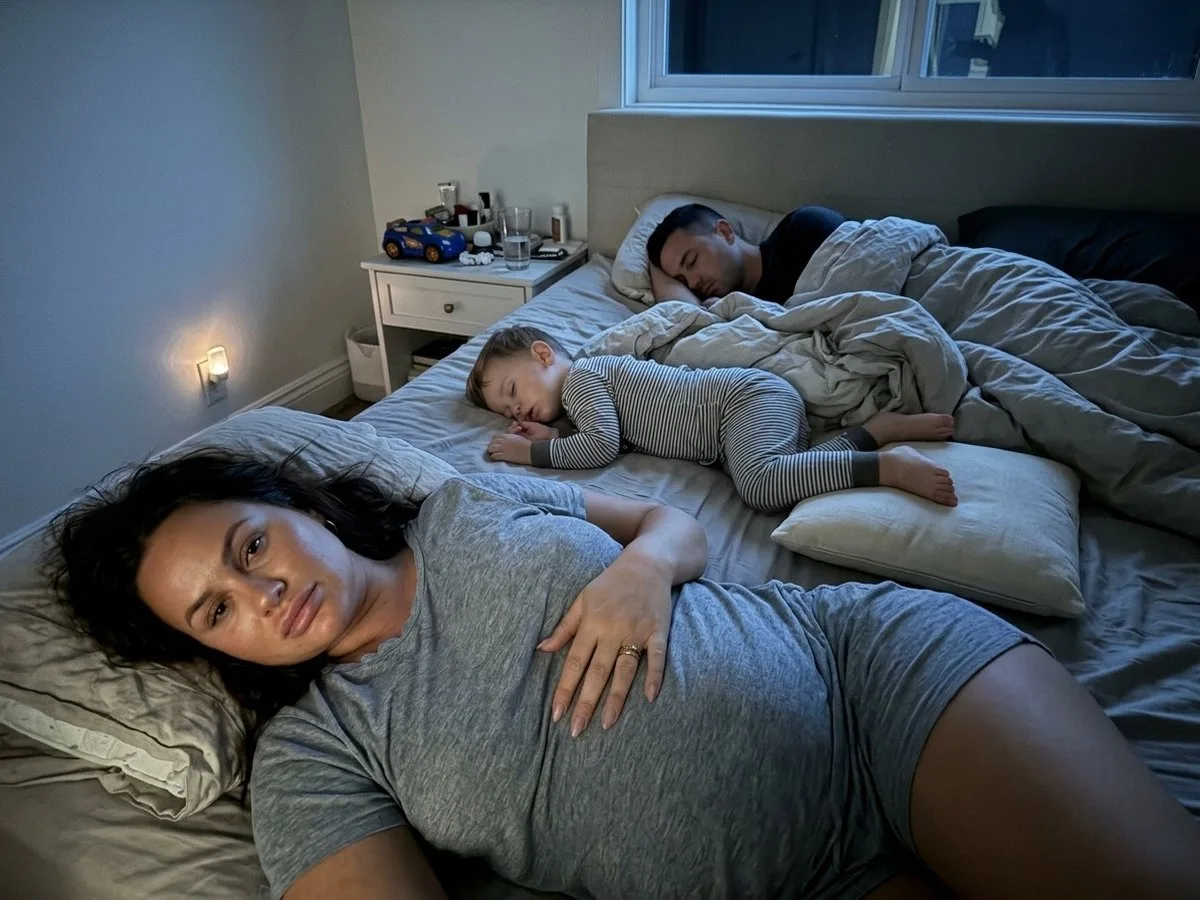
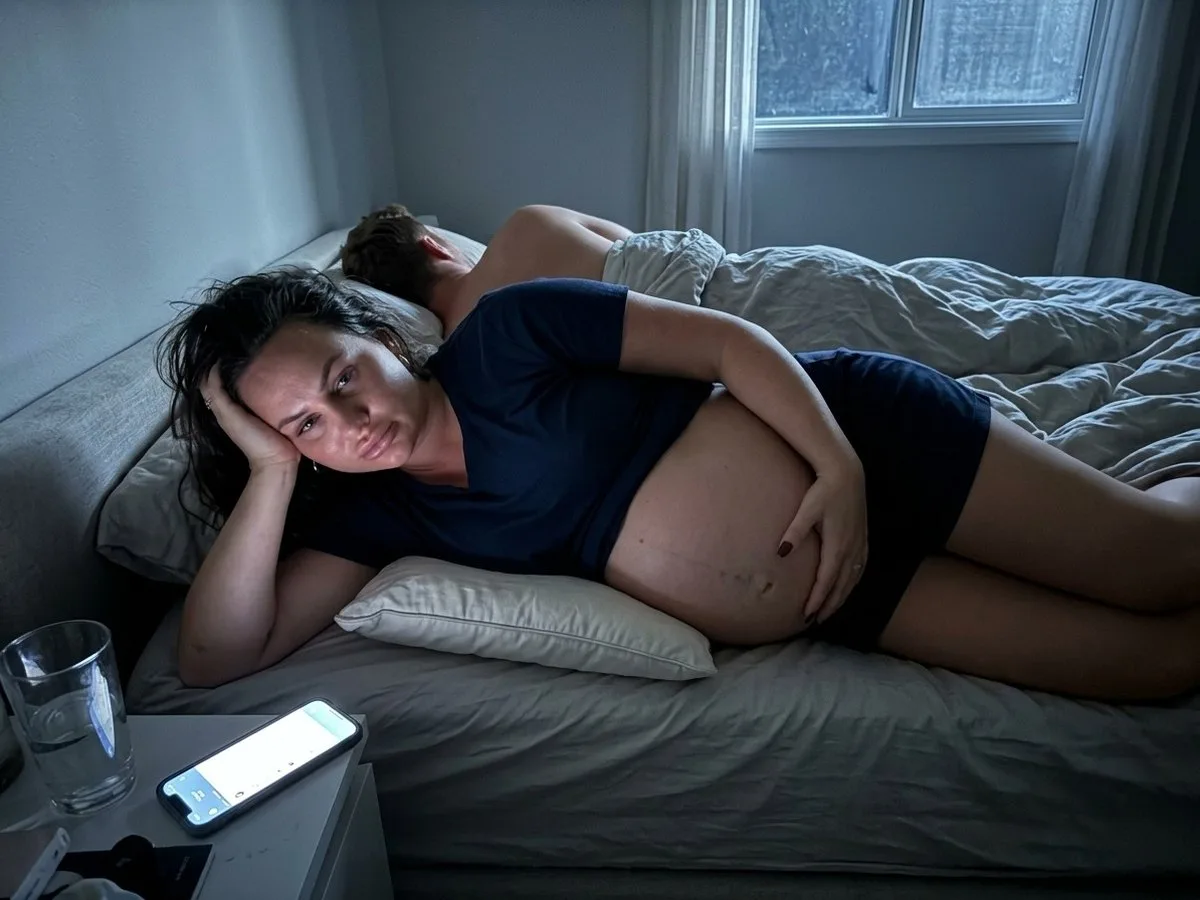
2:30 a.m.
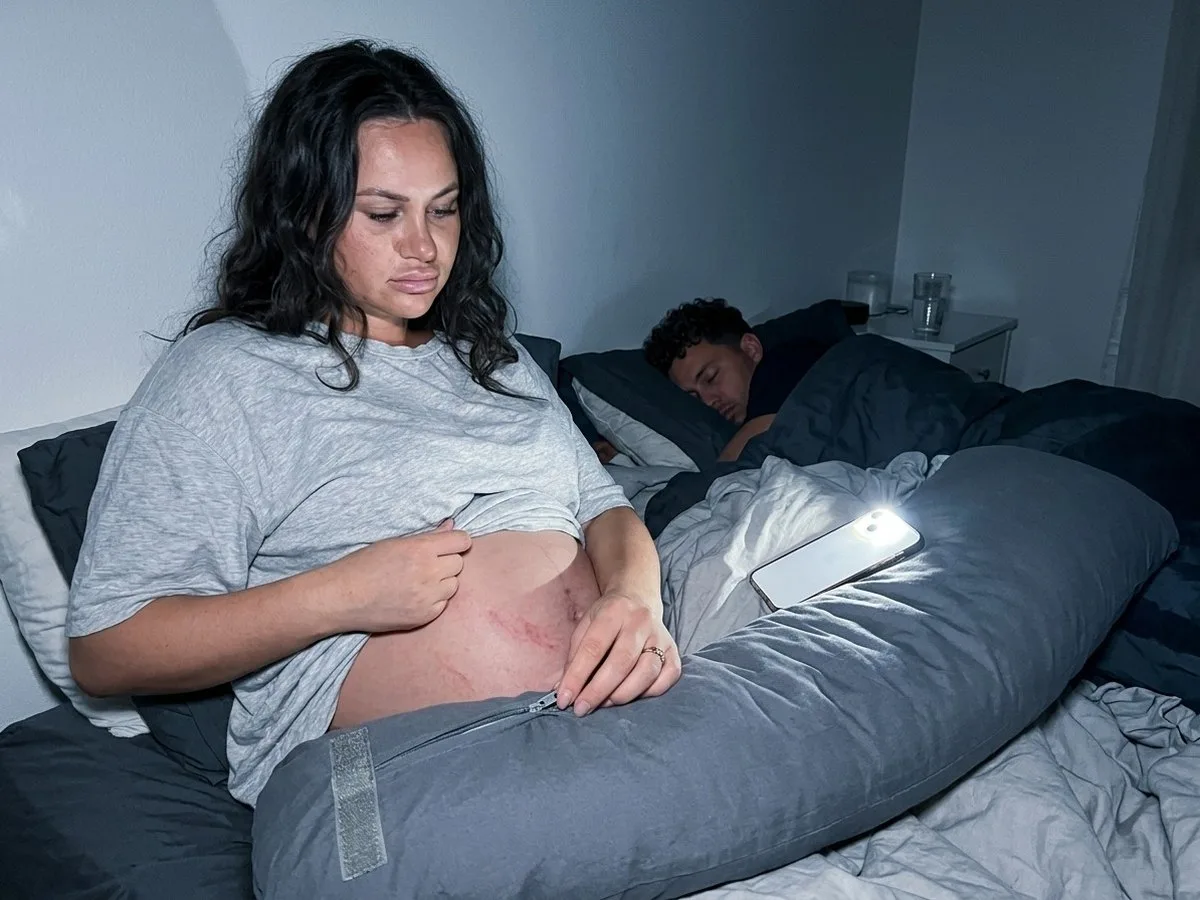
I was 31 weeks and I could feel it before I was even awake: the zipper pull, a little metal tab, pressing into my belly every time I settled. I would turn the pillow around. An hour later it had worked its way back.
The pillow had a strip of rough fastener on one end too. If I moved my leg it caught the inside of my knee like a cat's tongue. Owen said he could not even feel it. I could feel nothing else.
I have always been the person who cuts tags out of shirts. I just never thought to check a pillow for them.
- If you can feel a zipper pull through the cover in the dark...
- If a seam or raised edge leaves a line on your arm by morning...
- If you have turned the pillow around three times tonight to hide one spot...
- If you have always cut the tags out of your clothes...
You are not being difficult. Some bodies notice texture more, and a pillow sits against yours for eight hours.
"I couldn't keep the Velcro from scratching me! Especially if you toss and turn at night"Amazon review of a pregnancy pillow
"the corner of the velcroed pillow kinda stabbed me in the side"Amazon review of a pregnancy pillow
What sensitive sleepers usually try first
Most of us try to hide the rough spot rather than replace the pillow. It works for an hour at a time.
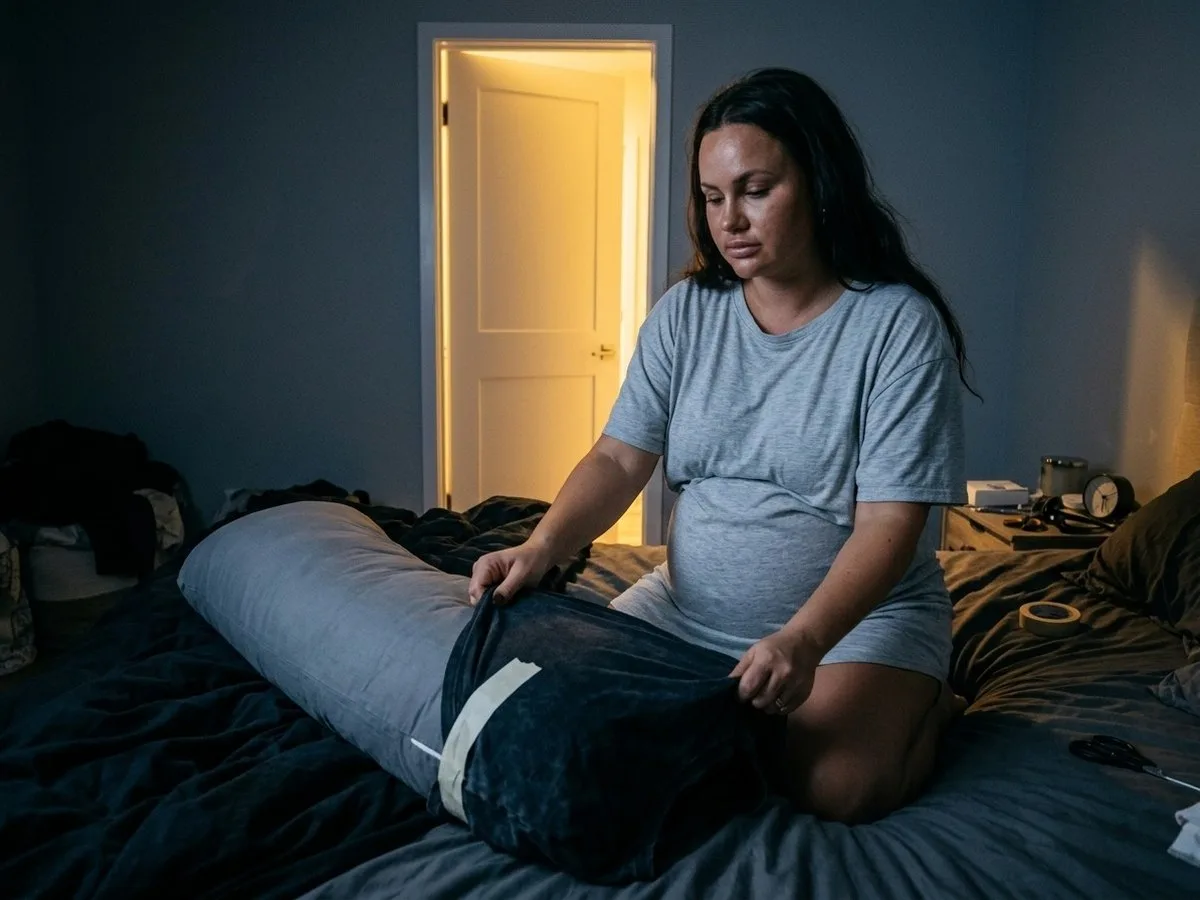
- Turning the zipper away.It stayed away until I turned over, and then I was lying on it again, half asleep, trying to rotate a pillow in the dark.Fixes one side of you, not both.
- Tape over the rough strip.The tape edge was its own new scratchy line, and it came loose in the wash.Swaps one edge for another.
- An old T-shirt as a barrier.Softer, but it bunched under my belly and slid off by morning.Soft, but does not stay.
- Sleeping without the pillow.No scratching. Also no support, and my hips told me about it by 4 a.m.Comfortable skin, sore body.
Is it sensitivity or an allergy?
This guide is about how a pillow feels: pressure, scratch and rub. A reaction to a material, such as a rash, itching that spreads or hives, is a different question for your doctor.
Pregnancy can make skin feel different, and itching in pregnancy can sometimes need checking. If you have itching without an obvious rough spot, or a rash where the pillow touches you, talk to your midwife or doctor before you blame the fabric.
Why do seams and zippers bother you so much at night?
Because a pillow presses your skin into it for hours, in the same few spots. A seam you would never notice on a sofa becomes a line pressed into your arm all night.
ClosuresZippers, pulls and hook-and-loop strips are hard or rough by design. Where they sit decides whether you ever touch them.
Seams and edgesA flat seam disappears. A raised seam, a thick corner or piping along an edge makes a ridge you lie on.
Tags and textureCare labels are often stitched into a seam you lie against. Pile fabrics also have a direction, smooth one way and rougher the other.
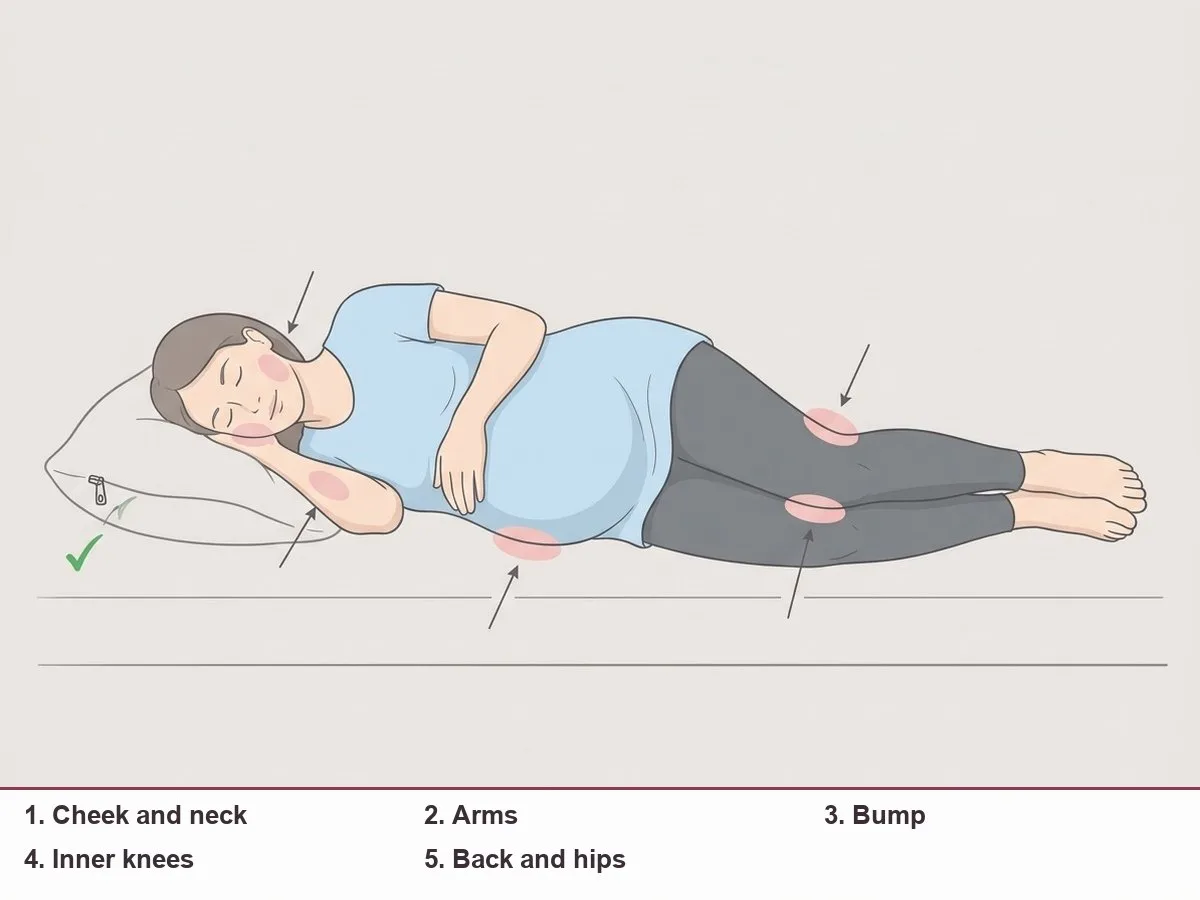
Pregnancy adds two things. You lie on your side for longer, so the same patch of skin carries the load all night. And a growing bump means more of you is pressed against the pillow than before. A seam that was fine at 20 weeks can be in the middle of your belly at 32.
The fabric name tells you almost nothing. The map of where things touch you tells you almost everything.
There is a way to get that map before you order, and a pillow design that keeps the hard parts off the spots you lie on. Both are below.
Where does a pregnancy pillow touch your skin?
Five places, mostly. Check each one on the listing, in the photos, or by asking the seller.
| Where it touches you | What usually sits there | What to check |
|---|---|---|
| Cheek and neck | The top end of a U or C, sometimes a seam line | Is there a seam across the head end? |
| Arms and hands | Edges you hug, piping | Piping or a flat edge? |
| Bump and belly | The curved inner side, often a zipper on long pillows | Which side the zipper runs along |
| Inner knees and thighs | The leg section, ends with closures | Any hook-and-loop or buckles here? |
| Back and hips | The outer side, straps on modular sets | Does a strap or fastener sit against you? |
A hidden zipper, tucked under a fabric flap, is easier to live with than an open one. A zipper along the outer edge, away from where you lie, is easiest of all.
What close-up photos should you ask for before you buy?
Ask for six close-ups. A seller who knows their product can send these in a day. If they cannot, that tells you something too.
- The zipper, open and closed, with the pull visible.
- The side the zipper sits on, photographed with the pillow in its sleeping position.
- A seam up close, so you can see if it is flat or raised.
- Every corner and end, where fabric is thickest.
- Any strap, buckle or hook-and-loop strip, and where it sits when you lie down.
- The care label, and where it is stitched.
Also ask whether the inside of the cover has any rough finishing. Covers turned inside out on photos sometimes show overlocked edges that will sit against you if you ever reverse the cover.
Can you make the pillow you have more comfortable?
Often, yes. Most rough spots can be covered, moved or removed without ruining the pillow.
- Photograph the care label, then cut it off close to the seam. You keep the instructions, you lose the scratch.
- Slip a soft cotton pillowcase over the part you lie on most, so seams sit under a smooth layer.
- Close hook-and-loop strips fully and fold any spare tab inward before bed.
- Turn the cover so the zipper runs along the side you face away from.
- Brush pile fabric with your hand to find its smooth direction, and set the pillow that way.
When is it worth replacing the pillow?
Replace it when the rough spot is built into where you lie and none of the fixes hold through a night. Tick the ones that sound like you:
- I wake up because of a zipper, strip or seam, not my body.
- I have tried a pillowcase barrier and it slides off.
- The hard part sits in the middle of where I lie.
- I spend part of the night turning the pillow, not myself.
- Seams have started to loosen and the edges feel rougher.
Two or more? Look for a pillow with no closures in your contact zones, and ask for the photos above before you order.
Which pregnancy pillow design is easiest on sensitive skin?
The easiest designs keep closures on the outer edge, use flat seams, and have fewer pieces of fabric touching you. Here is how common designs usually compare.
| U or C full-body | Long body pillow | Pillows held with hook-and-loop | Two wedges joined by a strap | |
|---|---|---|---|---|
| Fabric touching you | Most of your body | Front of your body | Several pieces | Bump and lower back |
| Zipper position | Often a long zipper, check the side | Often along one side | Varies | Ask for photos |
| Rough fasteners | Usually none | Usually none | Yes, at the joins | Strap sits between the pieces, ask how it attaches |
| Seams you lie on | Several, including the curve | One or two | Many edges | Few, check corners |
Fewer pieces and less fabric against you usually means fewer surprises. Still ask for the close-ups.
What changed once nothing scratched?
When nothing rough sits where you lie, you stop managing the pillow and start sleeping on it.
Cassie asked two sellers for the six close-ups. One sent them the same afternoon; the other sent a stock photo. She ordered from the first, cut the care label off after photographing it, and set the zipper on the side facing the wall.
The first night, she lay down and waited for the spot that would bother her. It did not come. Owen woke up at seven to find her still asleep, one hand tucked under her cheek, with nothing between her skin and the pillow but soft fabric.

Frequently asked questions
What pregnancy pillow is best for sensitive skin?
Look for closures on the outer edge or hidden under a flap, flat seams, no hook-and-loop in the spots you lie on, and a soft cover. Ask for close-up photos of each before you order.
Can a pregnancy pillow zipper scratch you?
Yes, if it sits where you lie. A zipper along the outer edge, or one tucked under a fabric flap, is much easier to live with.
How do I stop my pregnancy pillow from scratching me?
Photograph and remove the care label, cover the part you lie on with a soft cotton pillowcase, close fastener strips fully and turn the zipper to the side you face away from.
Is itching from my pillow an allergy?
Not necessarily. Scratch and rub are about texture. A rash, spreading itch or hives is worth checking with your midwife or doctor, and itching in pregnancy without a clear cause should be mentioned to them too.
Should I wash a new pregnancy pillow cover first?
Many people do, and it can soften some fabrics. Follow the care label for the cover, and wash the insert only if its own label allows it.
Is a hidden zipper worth paying more for?
If you notice textures, often yes. A flap over the zipper keeps the pull and teeth off your skin. Ask for a photo of it closed, since some flaps are too narrow to cover the pull.
Do pillow seams loosen over time?
They can, especially with frequent washing. Loose or fraying seams feel rougher and can let filling work out, so check them every few washes.
Where the Relvay 3-Piece pillow fits in
Relvay does not sell separate replacement covers, so if you need a new cover for a pillow you own, we are not the answer. If you are choosing a pillow, the 3-Piece is the low-contact setup Cassie's story describes: two small wedges under the bump and behind the back, with the strap sitting between the pieces rather than against your skin. Our product page does not yet show close-ups of the zipper and seams, so email us and ask for the six photos above before you order. Returns are within 90 days of delivery; return shipping is paid by you unless the item is faulty.
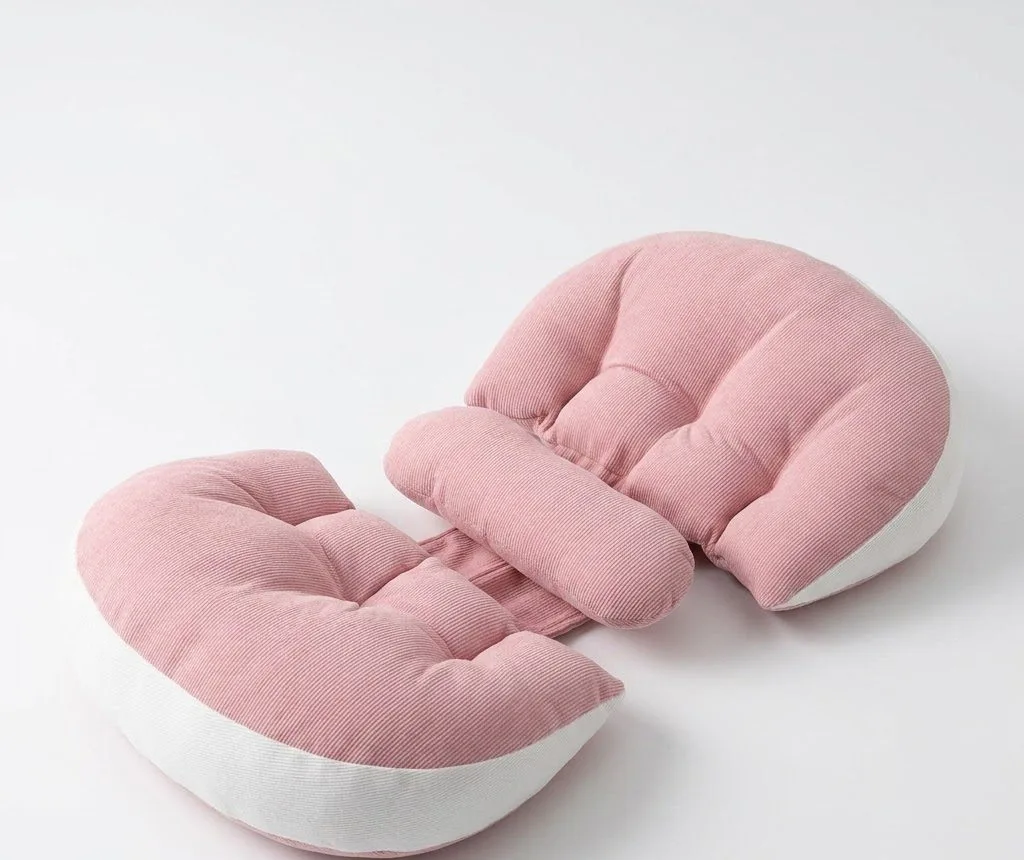
1. The bump wedgeA crescent-shaped wedge that tucks under your bump, thin edge toward your belly button, so the weight is not pulling on your back.
2. The back wedgeThe same shape, snug against your lower back so it has something to rest against.
3. The strap and small cushionA flat strap runs under you and joins the two wedges, so they stay together instead of drifting apart. A small oval cushion sits on the strap between them. You can set the distance as the bump grows.
Each wedge is about 17 by 13 inches and about 4 inches thick at its outer edge, tapering thinner toward your body (supplier measurement). Opened out, the set is roughly as wide as your torso, so it stays on your half of the bed and you keep your normal head pillow. Soft ribbed pink fabric on top, white sides. It is small enough to pack for a trip.
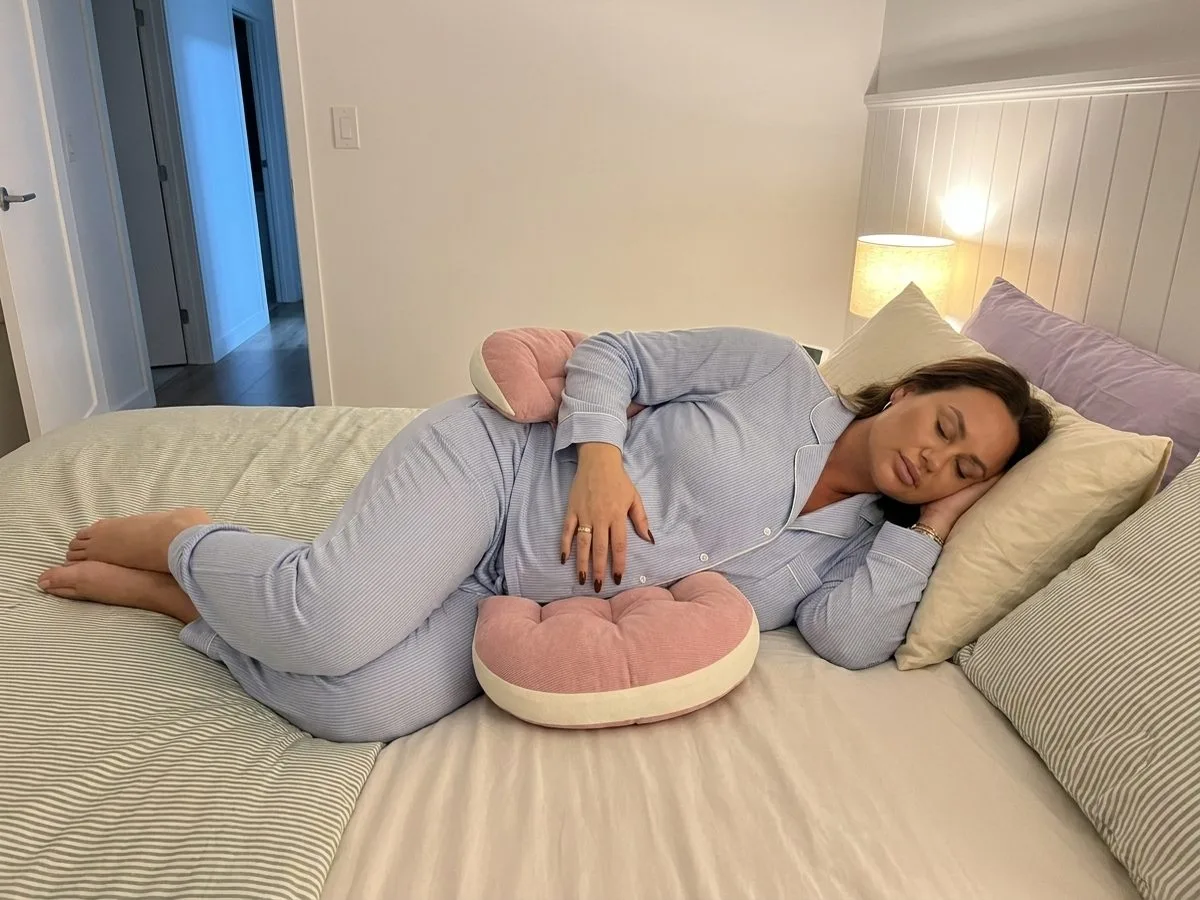
What it does not do: it does not go between your knees. Keep a regular pillow there, the way the NHS suggests. That combination covers all three points without a giant pillow.
Probably not for you if
- You only need a new cover for a pillow you own.
- You want cotton, not plush, against your skin.
- You have a rash or reaction that needs a doctor first.
Made for you if
- A big pillow puts seams and zippers all over you.
- You want less fabric touching you at night.
- You are happy to ask for close-ups before you order.
Try it for 90 nights
Sleep on it through the weeks that matter. If it is not right for you, email us within 90 days of delivery and send it back for a refund. Return shipping is on you unless it arrived faulty.
$79.99
90-day money-back guarantee · Free US shipping over $70 · 3 pieces, one set
Check price and availabilityCassie's story is a composite based on real reviews and public posts from pregnant sleepers. Names and details are changed.