
Relvay makes a pregnancy pillow. We also tell you below when you should not buy one.
The short answer
We found no pregnancy-specific rule for weighted blankets, so check two things: the product and you. Know its real weight and fill, make sure you can push it off and turn over easily, and ask your midwife or OB-GYN first.
- Skip the math: online body-weight rules were not written for pregnancy.
- Test: can you get out from under it when tired?
- Ask first: breathing, heart, blood pressure or circulation problems.
Is there pregnancy guidance on weighted blankets?
Not much yet. We did not find guidance on weighted blankets from a major pregnancy body. Most pages that rank for this question are written by bedding and mattress brands.
The one research project we found is a planned trial at Ataturk University, listed as NCT07309016 and marked not yet enrolling, with no results. Look at who it leaves out: high-risk pregnancies, preeclampsia, bleeding, twins, sleep apnea, asthma, and serious heart or circulation problems. Researchers are choosing very carefully who tries one, and that alone is a reason to ask before you do.
9:55 p.m.
I was 33 weeks and my head would not stop at night. A friend gave me her weighted blanket and said it changed her sleep. I spread it over me on the couch and it did feel calming, like a hug that stayed put.
Then I tried to get up for the bathroom. Getting my legs out took a whole-body shove I did not have at 33 weeks. I sat there under it thinking, what if I was half asleep?
A weighted blanket asks your body to move against it. That is the part to check in pregnancy.
Why don't the weight rules online fit pregnancy?
Because they were written for general adult use, and even then the blogs disagree. UCLA Health describes the accepted guidance as a blanket at or under 10% of a person's body weight, for adults in general.
Pregnancy pages then adjust that number in different directions, some by pregnancy weight, some by weight before pregnancy. None of the versions we saw came from a pregnancy guideline. Your weight also changes from week to week, and more of it sits in front of you, which changes how easily you turn and sit up.
So this guide does not give you a number to apply. The weight that matters is the one your care team is comfortable with for you, and the one you can actually move under. Those are the next two sections.
What should you check on the blanket or pillow itself?
Find the real total weight, what the weight is made of, how it is held in place, and what the maker says the product is for. If the listing only says "heavy" or "calming", you do not have enough to decide.
- Total weight: in pounds, from the label, not the photo.
- Fill: glass beads, plastic pellets or something else, and whether it can leak if a seam opens.
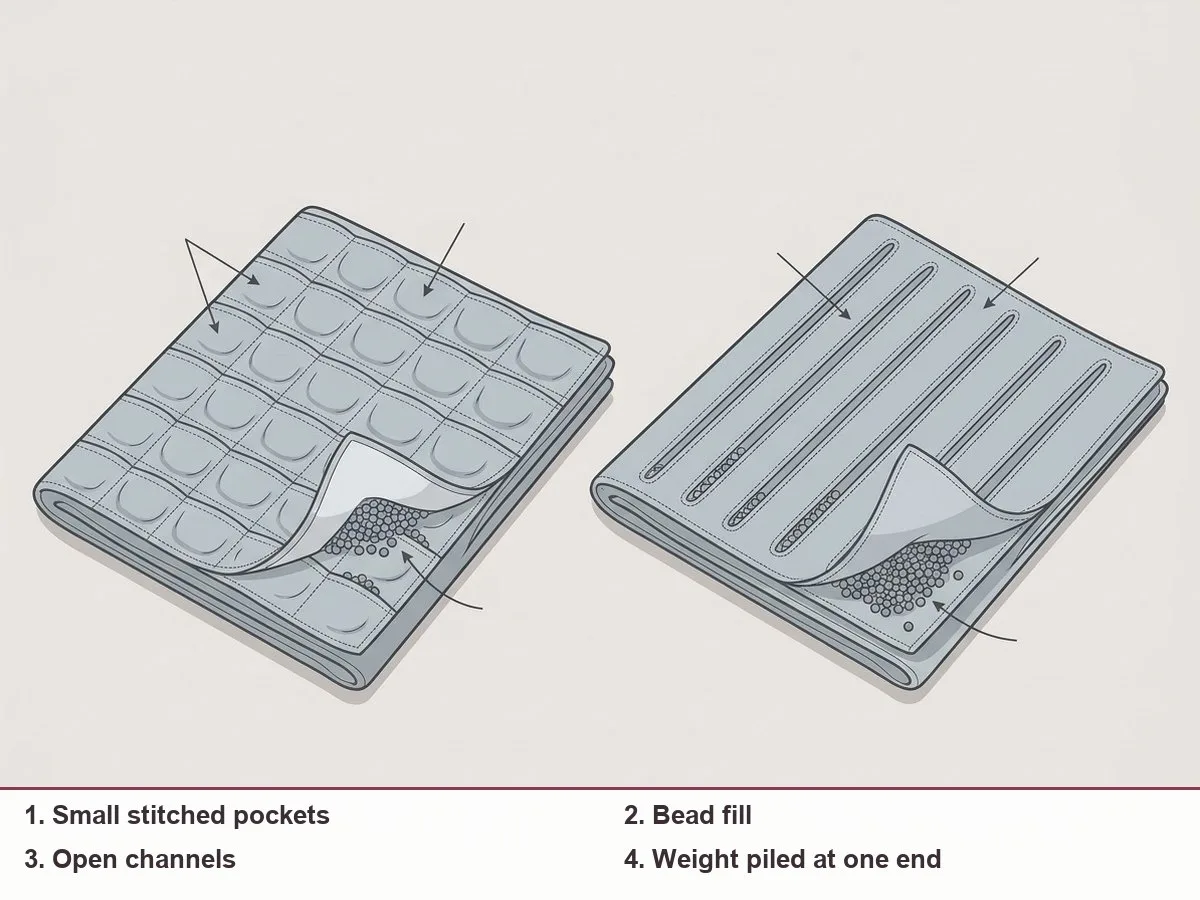
- Pockets: small stitched squares keep the weight spread. Large open channels let it slide and pile up.
- Size: a blanket wider than you can drape the weight over your partner's side too.
- Cover and warmth: heavy bedding can trap heat, and many people feel warmer in pregnancy.
- Washing: whether the cover comes off, and what the weighted insert needs.
- Intended use and warnings: what the manual says about who should not use it.
Weighted pillows and lap pads are the same question in a smaller size. Check the weight, the fill and the warnings the same way.
Can you get out from under it and change position?
Test it while you are awake, before you ever sleep under it. UCLA Health says weighted blankets should never be used by or on someone who could not remove the covering themselves, and pregnancy can quietly make that harder.
Try this in the evening, when you are tired, with someone nearby:
- Lie the way you usually fall asleep, with the blanket where you would have it.
- Turn to your other side without help and without lifting the blanket first.
- Sit up and get your legs out as if you needed the bathroom.
- Push it off with one arm, the way you would if you suddenly felt too hot.
- Notice your breathing and whether you feel squashed or warm anywhere.
If any step is hard, the blanket is too heavy or too big for you right now, whatever the box says. Your bump keeps changing, so repeat the test every few weeks. Night bathroom trips get more frequent later in pregnancy, which makes step three the one that counts most.
Who should ask before using one?
Anyone with breathing problems, heart problems, low blood pressure, circulation problems or diabetes should ask first. UCLA Health and Cleveland Clinic both name groups like these as people for whom a weighted blanket may be unsuitable.
In pregnancy, add one more rule: tell your midwife or OB-GYN even if none of those apply. Bring the product sheet and ask:
- Is a weighted blanket OK for me at this stage of pregnancy?
- Is this weight OK for me, or should I look at something lighter?
- Is there anywhere on my body it should not rest?
- Does anything in my pregnancy or health change your answer?
- If I want it for worry, leg discomfort or sleep, what else should we look at?
Some bedding brands suggest keeping the weight off the bump. That is a brand suggestion, not pregnancy guidance, which is exactly why it belongs on your list of questions.
What if you wanted it for anxiety or restless nights?
Tell your care team the reason, not just the product. Worry that keeps you awake and leg discomfort at night are both worth raising on their own, whatever you decide about the blanket.
Cleveland Clinic's write-up on weighted blankets presents the benefits as claims and says the effects vary from person to person. So a blanket is not a plan for anxiety. It is, at most, a comfort you might add once someone has heard what is going on.
Tori brought the product sheet and the get-out test to her 34 week visit. Her midwife looked at both, then asked how long the racing thoughts had been going on. That turned into the real conversation. The blanket went folded at the foot of the bed for now, and Tori left with a plan for the worry itself.
For the wider picture on sleep, positions and when to ask for help, see our pregnancy sleep guide.
Frequently asked questions
Is it safe to use a weighted blanket while pregnant?
We found no pregnancy guideline that answers this for everyone. Check the product, make sure you can get out from under it easily, and ask your midwife or OB-GYN, especially if you have breathing, heart, blood pressure or circulation problems.
How heavy should a weighted blanket be during pregnancy?
This guide does not give a number. The common 10% rule was written for general adult use, and pregnancy versions online disagree. Ask your care team, and use the get-out test to see what you can move under.
Can I put a weighted blanket over my bump?
Ask your care team. Some bedding brands suggest keeping the weight off the belly, but that is a brand suggestion, not pregnancy guidance.
Can my partner use a weighted blanket in our bed?
Many couples do. Keep it on their side and check that it does not drift over you during the night, so you can still turn and get up without pushing against it.
Will a weighted blanket help my anxiety in pregnancy?
Effects vary from person to person, and the claims mostly come from brands. Tell your care team about the anxiety itself so it gets proper attention.
If you would rather add support than weight, our pregnancy pillow buying checklist walks through size, fit and return terms in a few minutes.
Tori's story is a composite based on public posts from pregnant people about weighted blankets and sleep. Names and details are changed.