

Relvay makes a pregnancy pillow. We also tell you below when you should not buy one.
The short answer
A pillow that used to fit often stops working because the places you need support have moved, not because the pillow failed. Note your old setup, find tonight's gaps, then check how much adjustment the pillow has left.
- Adjust it if the gap is small and the pillow can reach it.
- Add a regular pillow if one point is uncovered.
- Change type only if three nights of adjusting fail.
Why does a pillow that fit last month stop feeling right?
Because your body changed shape around it. As the bump grows it sits further forward and lower, your back and hips carry it differently, and the gap between you and the pillow lands somewhere new.
1:40 a.m.
I was 31 weeks. For two months my setup had been perfect: one wedge under my bump, my head pillow, done. I used to fall asleep in ten minutes.
That night I woke up for the third time with the wedge pressing into the top of my bump instead of holding the bottom of it. My lower back felt like it was hanging off a ledge. I pushed the wedge down, then up, then gave up and lay there staring at Theo's back, wondering what I had done wrong.
Nothing, it turned out. The pillow was in the same place it had always been. I was the thing that had moved.
- If the pillow that felt like a hug in month five now feels like it is in the wrong spot...
- If you keep adding regular pillows on top, one more every week...
- If you wake up with an ache somewhere new...
"Rounding 26 weeks, it's starting to feel awkward...not getting to sleep as easy as I used to. Toss and turn all night until I just finally fall asleep"YouTube comment on a pregnancy sleep video
"Im 28 weeks and so uncomfortable no matter if i use a support cushion or not. I just find it so hard to sleep."YouTube comment on a pregnancy sleep video
You did not outgrow your pillow. You outgrew your old setup.
What usually changes: you, the pillow or the setup?
Usually all three a little. Check each one before you decide the pillow is the problem.
YouThe bump sits further forward, the gap between bump and mattress gets taller, and a new sore spot may appear in your hips, back or ribs.
The pillowFilling can flatten or clump, a washed cover can grip tighter, and parts can slide away from where you first put them.
The setupExtra pillows pile up, you switch sides more, or you moved to a different bed or mattress.
None of this follows a fixed calendar. Some people never need to change anything. Others change their setup twice. Go by what your nights tell you, not by the week number.
How do you recheck your setup in 10 minutes?
Lie down in your usual sleep position with the pillow where you normally put it, and check five support points one by one. Write down what you find next to what you used to do.
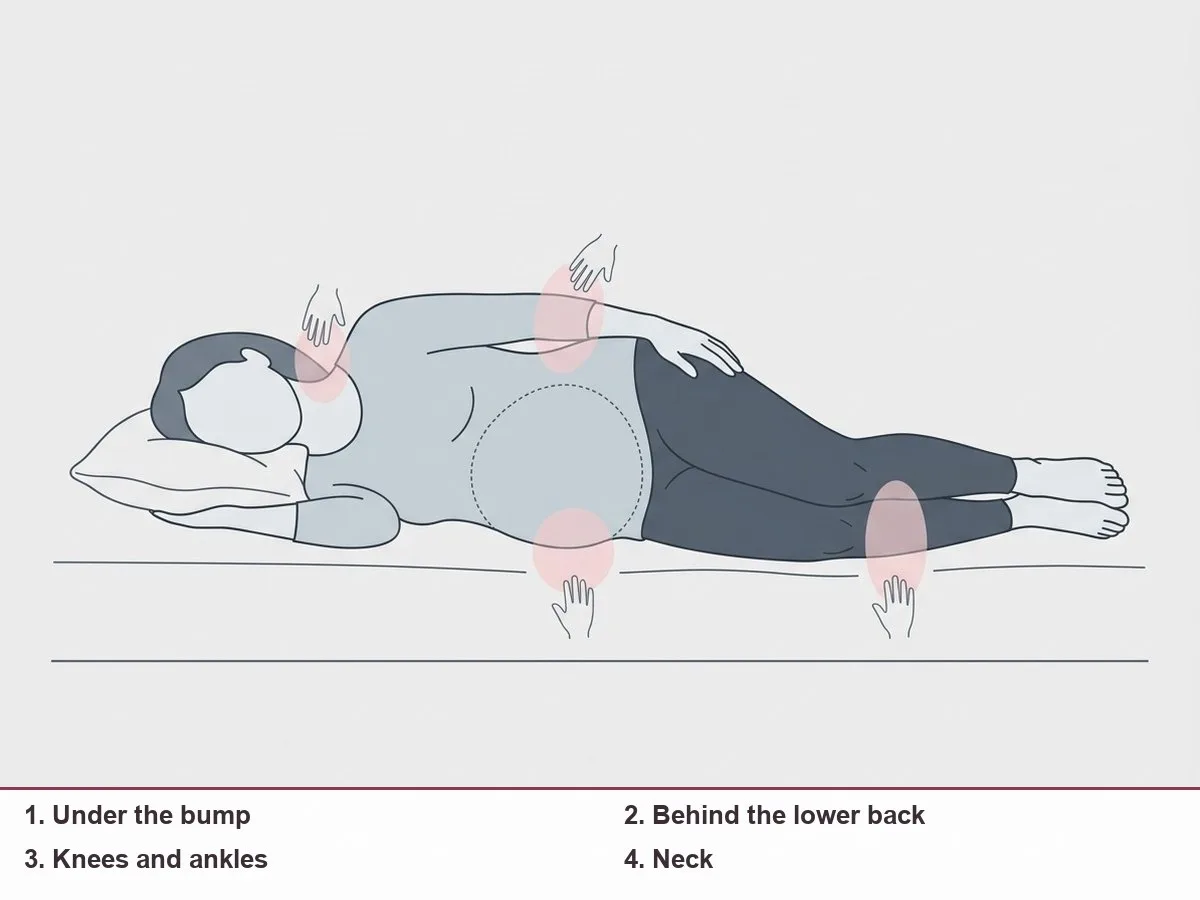
- Write down the old setup. Where each pillow went when it still worked. A phone photo of the bed at bedtime is enough.
- Lie on your usual side and relax fully for one minute. Tension hides gaps.
- Slide a flat hand into each gap: under the bump, behind the lower back, between the knees and ankles, under the neck.
- Mark each point as held, gap or pressing.
- Repeat on the other side. Many people only check the side they start on.
| Support point | When it worked | Tonight | What it usually means |
|---|---|---|---|
| Under the bump | Wedge under the middle | Gap at the bottom, pressing at the top | Move support lower and further out |
| Behind the lower back | Nothing needed | Back feels like it hangs | A new point needs support |
| Between knees and ankles | Pillow at the knees | Top ankle drops | Make the leg support longer |
| Head and neck | One pillow | Neck bent up or down | Head height no longer matches the body |
| Getting out of bed | Easy | Have to climb over pillows | The setup has grown too big |
Keep this table. Next time it stops feeling right, you will see what moved instead of starting from zero.
How much adjustment does your pillow have left?
Every pillow can only move so far. Check the range of the one you own before you buy anything, because a small change inside that range often closes the gap.
| Pillow type | What you can still change | Out of range when |
|---|---|---|
| Regular pillows | Swap firmness, fold, stack, move each one | They drift apart every time you turn |
| Single wedge | Move lower or further out, turn the thick edge, add a folded towel under it | You now need bump and back at once |
| U or C pillow | Shift the curve, remove filling if it has an opening and the label allows it | The curves no longer meet your bump or back |
| Connected wedge set | Change the distance between the parts, swap which side faces you | The parts are at their widest and still miss |
Check the care label before you open any filled piece. If the label says nothing about removing filling, leave it closed. For fit by body size, our pregnancy pillow size guide covers length and inner space.
Should you adjust, add a pillow or change type?
Adjust first, add a regular pillow second, and change type only when the pillow cannot reach the gap after three nights. Bigger is not automatically better.
AdjustThe gap is small and the pillow can move there. Try it for three nights.
AddOne point is new and uncovered, like the lower back. A regular pillow there is free.
ChangeThe pillow is at its limit, or the added pillow drifts every night.
Sharp, new or one-sided pain is not a pillow question. Tell your midwife, doctor or a women's health physiotherapist. The NHS advises going to sleep on your side from 28 weeks, so the goal is a setup that keeps side sleeping comfortable, not a perfect pillow.
Amelia moved her wedge lower and further out, so it held the bottom of her bump again. That fixed the front. Her back still had nothing, so she wedged a folded pillow behind it. For two nights it worked. On the third it was on the floor by 2 a.m. That was her answer: the front could be adjusted, the back needed support that stayed joined to it.
Frequently asked questions
Why is my pregnancy pillow suddenly uncomfortable?
Most often because your bump now sits lower and further forward, so the support lands in the wrong spot. Flattened filling or a cover that shrank in the wash can add to it. Recheck where the gaps are before replacing anything.
Do I need a bigger pregnancy pillow in the third trimester?
Not automatically. Many people only need to move the pillow lower, add a regular pillow behind the back, or lengthen the support between the knees and ankles.
How often should I adjust my pregnancy pillow?
Whenever your nights change: waking to rearrange, a new ache, or adding pillows. There is no set schedule.
Can I remove filling to make my pregnancy pillow fit better?
Only if it has an opening for that and the care label allows it. If the label says nothing, leave it closed.
What if nothing feels comfortable anymore?
Try the recheck on both sides for three nights. If you still cannot get comfortable, or you have new or sharp pain, talk to your midwife or doctor.
If your pillow has run out of adjustment
If the recheck shows you now need bump and back support at the same time, and loose pillows will not stay behind you, a connected set is one option. The Relvay 3-Piece joins two small wedges with a strap, and you set the distance between them as the bump grows. It will not fix a gap between your knees, and if adjusting your current pillow worked, you do not need it.

Two wedges for bump and back, joined by a flat strap, about as wide as your torso. Keep a regular pillow between your knees. $79.99, 90-day returns.
Choosing from scratch instead? Start with our pregnancy pillow size guide to match the pillow to your body.
Amelia's story is a composite based on real reviews and public posts from pregnant side sleepers. Names and details are changed.