
Relvay makes a pregnancy pillow. We also tell you below when you should not buy one.
The short answer
Short stretches are usually fine, and the advice gets more careful as pregnancy goes on. The NHS says to avoid activities that keep you flat on your back for more than a few minutes in later pregnancy. What applies to you depends on your situation, so ask your care team.
- Awake: you can notice symptoms and move.
- Turn now: if you feel dizzy, breathless or your heart races.
- Ask about: exercise, massage, exam and dental chairs.
Why is lying on your back while awake different from sleeping?
Because awake, you can feel how you are doing and change position. Asleep, you cannot. That is why sleep guidance and daytime guidance are worded differently.
Cleveland Clinic puts the awake case simply: it is OK to find yourself on your back for a brief spell, like lounging through a TV show. The concern later in pregnancy is long stretches, like spending a whole night flat.
This guide is about the awake part of your day. For bedtime positions, see our pregnancy sleep guide. If you are worried about finding yourself on your back in the night, that has its own guide: accidentally sleeping on your back while pregnant.
Saturday, 9:15 a.m.
I was 24 weeks and back at my regular yoga class. The teacher said, "Everybody onto your backs for the next sequence." Nine people lay down. I froze on my mat, half up, half down, trying to remember whether this was one of the things I was not supposed to do anymore.
Three days later I was in a dentist's chair tipped all the way back, with the same question and a mouth full of cotton.
Nobody had told me the answer depends on how long, how flat and how I feel. I just knew there was a rule somewhere.
What does the guidance say about later pregnancy?
Sources agree that lying flat on your back for long periods becomes less advisable as your bump grows. They word the timing differently, so your own midwife or OB-GYN is the one to tell you what applies.
- NHS: in later pregnancy, avoid any activity that involves lying flat on your back for more than a few minutes, because it can make you feel dizzy.
- MotherToBaby: in the second and third trimesters, avoid exercise that involves lying flat on your back, because it reduces blood flow.
- Cleveland Clinic: after about 20 weeks, the uterus can press on major blood vessels when you lie on your back, so do not spend the whole night flat.
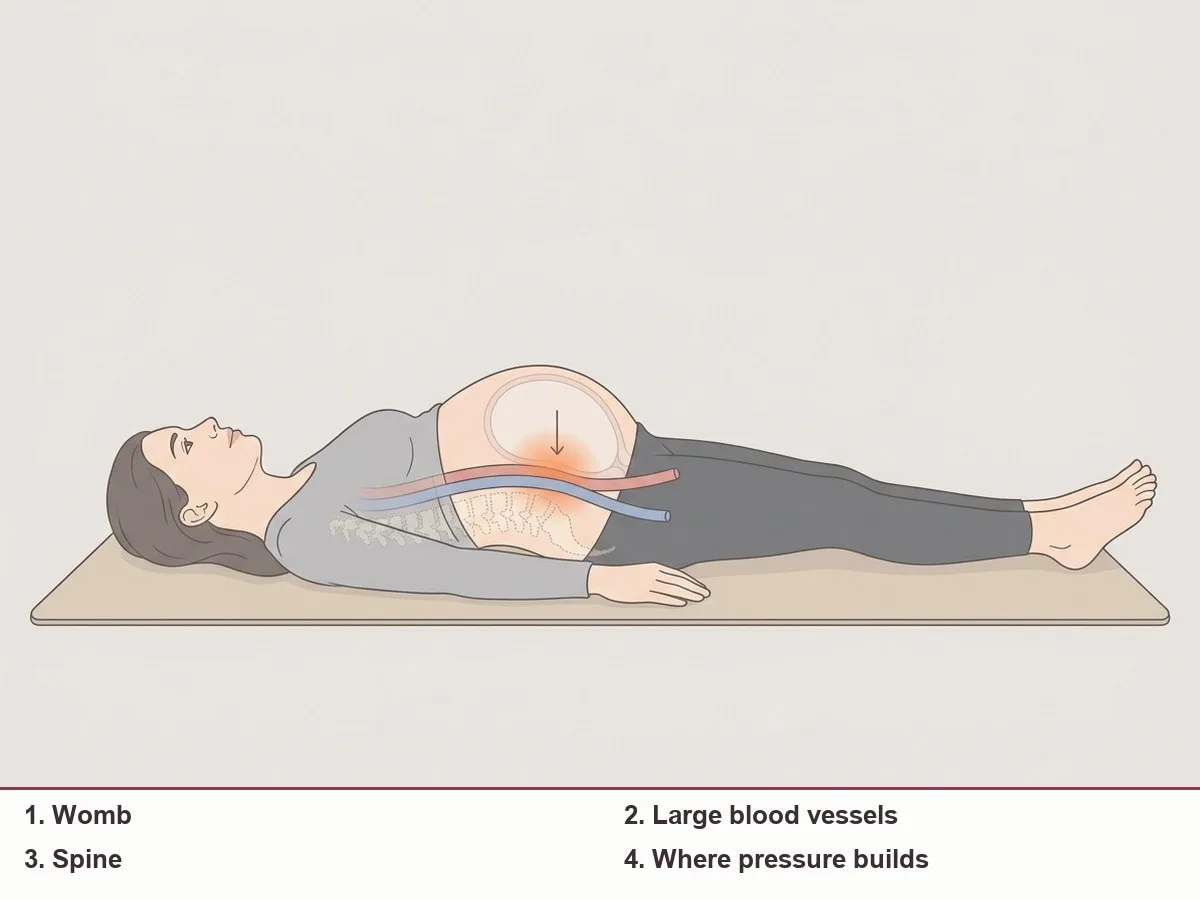
The reason is pressure. As the womb gets heavier, lying flat can press on the large blood vessels that run along your spine. Some people feel that quickly as lightheadedness. Others feel nothing at all. Neither tells you a safe number of minutes, which is why we do not give one here.
Which everyday situations should you ask about?
Think about where in your week you end up lying back: exercise, appointments, treatments and resting at home. Each one is worth a specific question, because the answer can differ.
| Situation | Why it comes up | What to ask |
|---|---|---|
| Exercise class or home workout | Many core and stretching moves start on your back. | Which moves should I change, and from which week? |
| Massage or physical therapy | Tables are flat and sessions are long. | Tell the therapist your weeks. Ask what position they use for pregnancy. |
| Dental or exam chairs | Chairs tip back for access. | Tell staff you are pregnant and that you will say if you feel dizzy. |
| Scans and checkups | You may lie back for a while. | Staff deal with this every day. Say how you feel during it. |
| Resting at home | Reading, phone, TV, propped or flat. | Is propped up different from flat for me? When should I switch to my side? |
| Getting up from lying | Sitting straight up can feel hard later on. | Ask your team to show you how they want you to get up. |
None of these questions is fussy. People who work with pregnant patients hear them all day, and a clear answer for your body beats a rule you half remember from the internet.
Which symptoms mean you should turn onto your side now?
If you feel lightheaded, dizzy, short of breath, sick, or your heart starts racing while you are on your back, turn onto your side. Cleveland Clinic advises rolling onto your side if you have a little trouble breathing or your heart beats faster.
Then give it a few minutes. Most of the time the feeling passes once you are off your back.
Call your care team if it does not pass, if it keeps happening, or if you faint. The CDC lists dizziness or fainting among its urgent maternal warning signs. Seek care right away for chest pain, trouble breathing that does not settle, severe belly pain, or bleeding or fluid leaking.
What should you bring to your next appointment?
Bring a short note of what you do on your back, roughly how long, and how you feel when you do. That lets your midwife or OB-GYN give you advice for your situation instead of a general rule.
- How many weeks you are, and anything that makes your pregnancy different, like twins or blood pressure problems.
- The activities where you lie back: class names, appointments, how you rest at home.
- Roughly how long each one keeps you on your back.
- Any symptoms you noticed, and how quickly they passed once you moved.
- Your questions: Which positions should I avoid while awake, and from when? What should I do instead in my workouts? Which symptoms mean I should call?
Tiana typed the list into her phone the night after the dentist. At her 25 week visit her midwife went through it line by line, said which moves to swap in yoga and told her what to say in any chair that tips back. Tiana showed the same note to her yoga teacher the next Saturday. The sequence got a side-lying version for the whole class.
Frequently asked questions
How long can I lie on my back while pregnant?
No single number fits everyone. The NHS says to avoid lying flat on your back for more than a few minutes in later pregnancy. Ask your midwife or OB-GYN what applies to you, and turn onto your side if you feel unwell.
Can I lie on my back in the first trimester?
Most sources are not concerned about lying on your back early in pregnancy. MotherToBaby's exercise advice about lying flat starts in the second trimester. If you have a specific worry, ask your care team.
Can I do exercises on my back while pregnant?
MotherToBaby advises avoiding exercise that involves lying flat on your back in the second and third trimesters. Ask your care team which moves to change and what to do instead.
Is lying propped up the same as lying flat?
The guidance we cite talks about lying flat. Whether propping up changes things for you is a question for your midwife or OB-GYN. We do not give a general angle.
What should I do if I feel dizzy lying on my back?
Turn onto your side and give it a few minutes. If it does not pass, keeps happening or you faint, call your care team. Dizziness or fainting is on the CDC's list of urgent maternal warning signs.
If side lying is where you are spending more of your time, our pregnancy pillow buying checklist helps you choose support that fits your bed.
Tiana's story is a composite based on public posts from pregnant people about exercise classes and appointments. Names and details are changed.