Relvay makes a pregnancy pillow. We also tell you below when you should not buy one.
The short answer
Öko-Test is a German magazine that buys products and grades them. OEKO-TEX is a certificate that a textile passed tests for harmful substances. Neither one tells you whether a pillow fits your bed or your body.
- Check: label name, number, holder and date.
- Match: which part it covers, cover or filling.
- Comfort: a separate test, done in your bed.
Why do pregnancy pillow labels get so confusing?
Because several different kinds of label sit side by side on the same listing: magazine ratings, textile certificates, foam certificates and plain marketing words. They look alike and answer different questions.
9:40 p.m.
I was 22 weeks and my sister-in-law in Munich had just texted me a screenshot. "This one got sehr gut from Öko-Test!" Ten minutes later I was looking at a US listing with an OEKO-TEX badge, a CertiPUR-US badge and the word hypoallergenic in a little green leaf.
I honestly thought Öko-Test and OEKO-TEX were the same thing spelled two ways. They are not even close. And none of those badges told me the one thing I was scared of, which was buying another pillow that would not stay put when I turned over.
A label answers one narrow question. Your job is to know which question, and which part of the pillow.
Which label checks what? A side-by-side table
Each label below checks something real, but each stops at a clear line. Use the last column before you trust a badge.
| Label | Who issues it | What it checks | What it does not prove | How to verify |
|---|---|---|---|---|
| Öko-Test rating | A German consumer magazine | Products bought anonymously, sent to outside labs, graded from "sehr gut" to "ungenügend". Strong focus on pollutants. | That the pillow you see is the tested model, size or year. Fit or comfort for you. | Find the test issue and year, and match the exact product name. |
| OEKO-TEX STANDARD 100 | OEKO-TEX | Textiles tested against a list of harmful substances. Stricter classes for more skin contact. | Allergy to a specific fiber. How it feels, lasts or supports you. | Enter the certificate number in the OEKO-TEX Label Check, or scan the label's QR code. |
| CertiPUR-US | A US foam certification program | Foam only: emissions and certain chemicals. | Anything about the cover or a non-foam filling. | Ask which foam part is certified and by whom. |
| GOTS | Global Standards, which runs the Global Organic Textile Standard | Processing of certified organic fibers along the supply chain, with environmental and social criteria. | That every part of the pillow is organic, or right for your skin. | Ask for the certified company name and look it up in the GOTS certified suppliers list. |
| "Hypoallergenic" | The seller | Nothing set. The FDA says the term has no federal definition. | Anything specific. | Ask for the full material list instead. |
What does an Öko-Test rating prove?
It proves that one product, at one point in time, scored a grade in that magazine's test. It is a review, not a certificate, and it belongs to the tested model.
Helpful: independent purchase, outside labs and a strict view on pollutants. Products can score poorly even when they meet legal minimums.
Limits: the grade does not travel. A newer version, a different size or a cover in another fabric is not automatically the tested product. Most Öko-Test tests are in German and many results sit behind a paywall, so a screenshot is easy to share and hard to check.
If you searched "Schwangerschaftskissen Öko-Test", the question to ask is simple: which issue, which year, and is it this exact pillow?
What does an OEKO-TEX label prove?
It proves the certified textile passed testing for a long list of harmful substances under that standard. It does not rate comfort, support or durability.
Helpful: every thread, button and accessory of the certified article is in scope, and products for babies and close skin contact have stricter limits. You can check a number yourself in the OEKO-TEX Label Check.
Limits: the certificate covers what is named on it. A listing can show the badge because the cover fabric is certified while the filling is a separate story. And it was never meant to answer allergy questions about a particular fiber. For that, see pregnancy pillow materials when you have a known allergy.
What about foam and organic labels?
CertiPUR-US speaks only for foam, and GOTS speaks only for certified organic textile processing. Both are useful inside their lines and silent outside them.
CertiPUR-US lists foam made without formaldehyde, certain phthalates and heavy metals, with low emissions. If the pillow is polyester fiber or microbeads, the badge has nothing to say about the filling.
GOTS follows certified organic fibers through processing. "Organic cotton cover" on a listing is not the same as a GOTS certified product, so ask who holds the certificate.
How do you check a certificate claim on a listing?
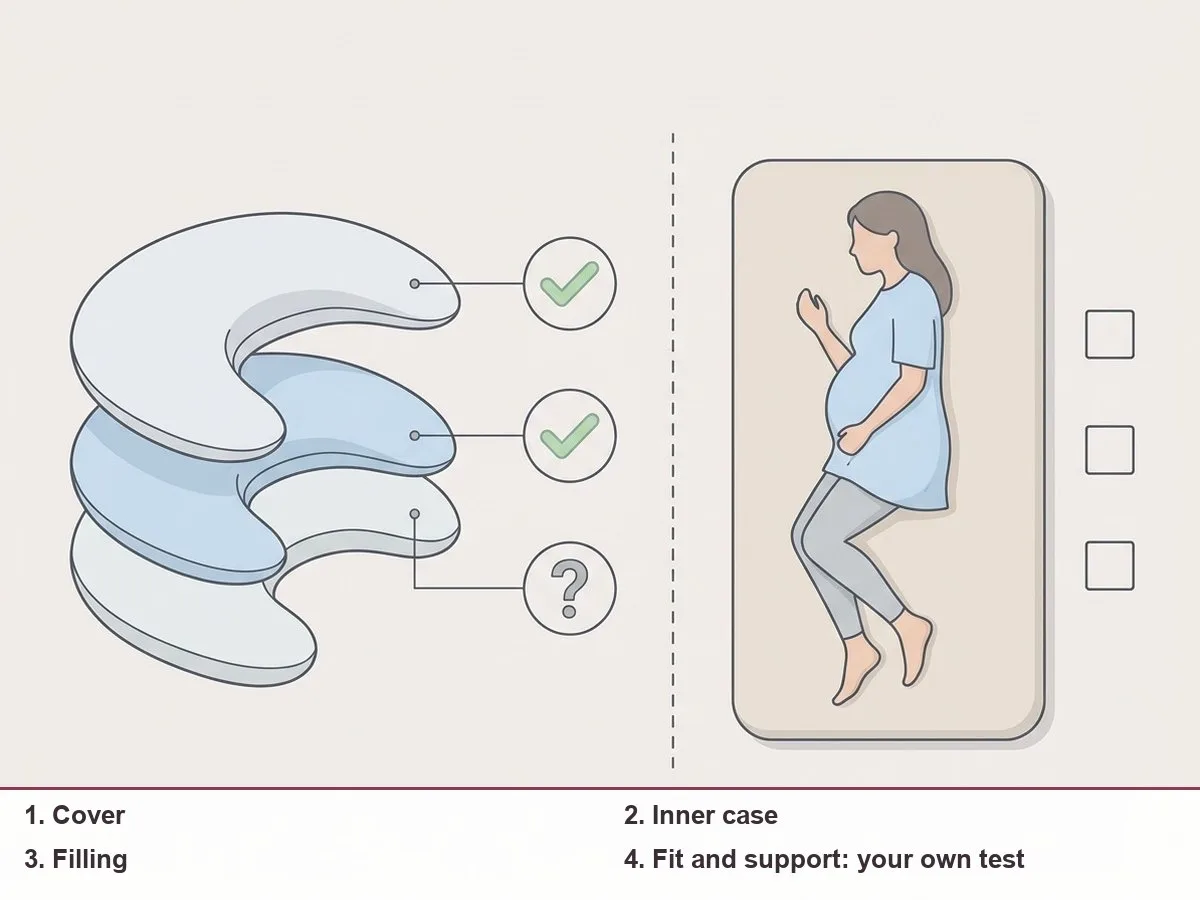
Ask for five things in writing: the label name, the certificate number, the holder, the part it covers and the date. If any one is missing, the badge is a picture, not proof.
Copy this sheet for each pillow you are comparing:
| Line | What a complete answer looks like | Red flag |
|---|---|---|
| Label name | The exact standard, for example OEKO-TEX STANDARD 100 | "Eco certified", "tested", a leaf icon |
| Number | A certificate or test number you can look up | "Available on request" that never arrives |
| Holder | A company name that matches the maker or a named supplier | A different product or company |
| Scope | Which part: cover, inner case, filling, whole pillow | Badge on the photo, no part named |
| Date | Valid now, or a test year that matches the version sold | An old test for a pillow that has since changed |
We are explaining how to read a label, not how any law applies to it. If a claim matters for health reasons, take the sheet to your doctor.
What no label can tell you
No certificate measures whether a pillow fits your half of the bed, holds your bump and back, or stays with you when you turn. Those are separate checks, and they decide whether you keep it.
Daphne ended up with two lists on the fridge. One was materials and labels, the things a certificate can answer. The other was her bed width, the spots that ached and how often she turned at night. The second list is the one that picked the pillow. Our pregnancy pillow buying checklist covers it.
Frequently asked questions
Is Öko-Test the same as OEKO-TEX?
No. Öko-Test is a German consumer magazine that buys products and grades them. OEKO-TEX STANDARD 100 is a label that marks textiles that passed tests for harmful substances.
Has Öko-Test tested pregnancy pillows?
We could not confirm a current Öko-Test result for pregnancy pillows when we wrote this. If someone shows you a grade, ask for the issue and year and match the exact product name before relying on it.
How do I check an OEKO-TEX certificate?
Ask for the certificate number and enter it in the OEKO-TEX Label Check on their website, or scan the QR code on the label. Then check which part of the pillow the certificate names.
Does a certified pregnancy pillow help you sleep better?
Not by itself. Certificates test materials. How well a pillow supports your bump and back, fits your bed and behaves when you turn is a separate question.
What does CertiPUR-US cover on a pregnancy pillow?
Only foam. It says nothing about the cover fabric or about fillings that are not foam, such as polyester fiber or microbeads.
Where the Relvay 3-Piece stands on labels
We sell one pregnancy pillow, the Relvay 3-Piece, and we hold it to the same sheet. Today we do not publish a certificate for it, and our product page says the full fabric composition will be posted once we have the spec in writing. If a certificate is your first filter, it is not your pick yet. If your first filter is bump and back support that stays on your half of the bed, here is what it is.
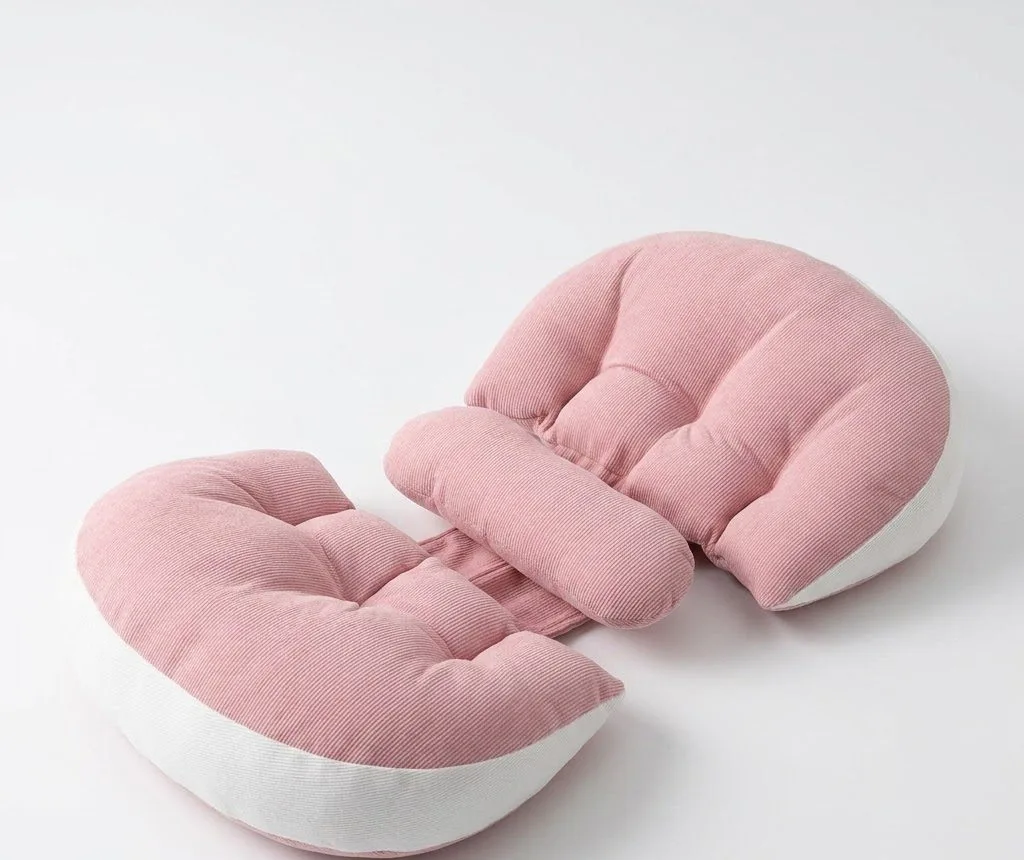
Two wedges for bump and back, joined by a flat strap, about as wide as your torso. Keep a regular pillow between your knees. $79.99, 90-day returns.
Probably not for you if
- You need a named certificate before you buy.
- You have a known allergy and need every layer listed in writing first.
- You want one pillow that also wraps your head and knees.
Made for you if
- Your bump and lower back need support at the same time.
- You share a full or queen bed.
- You want 90 days to decide in your own bed.
Daphne's story is a composite based on public posts from pregnant shoppers comparing pillow labels. Names and details are changed.