Relvay makes a pregnancy pillow. We also tell you below when you should not buy one.
The short answer
"Hypoallergenic" is not a legal standard in the US, so on its own it tells you very little. With a known allergy, ask the seller what every layer is made of, then check that list with your allergist or doctor.
- No layer list: treat the label as marketing.
- Ask about: cover, filling, inner case, zip, elastic and any finish.
- Certificates: they test for set substances, not for your allergy.
Why doesn't "hypoallergenic" answer your question?
Because nobody checks what it means. The FDA says there is no federal standard or definition for "hypoallergenic", so the word means whatever the company using it wants it to mean.
That matters more when you are not shopping for a vague "gentle" pillow but working around one thing you already know you react to. A label made for everyone cannot tell you whether your trigger is inside.
11:20 p.m.
I was 23 weeks, sitting up in bed with my phone, and every listing said the same word. Hypoallergenic. One pillow was full of polyester fiber. One was shredded foam. One said "natural" and turned out to be latex inside, which is the one thing my allergist told me years ago to keep away from my skin.
Same word on all three. Three completely different insides. I closed the tabs and opened my email instead.
The useful question is not "is it hypoallergenic?" It is "what exactly is in each layer?"
What should you ask about each layer of a pregnancy pillow?
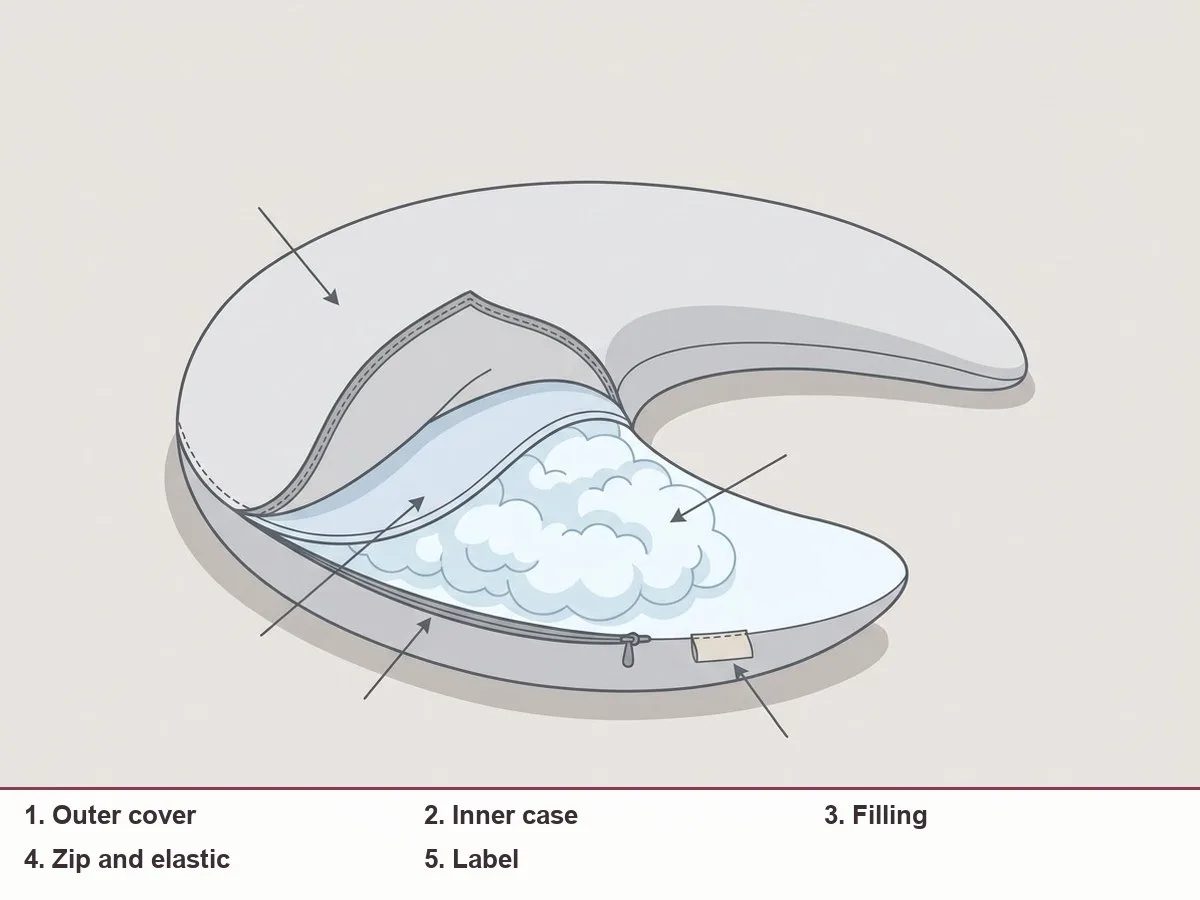
Ask about every part your skin or breath can reach: the outer cover, any inner case, the filling, and the small parts like zips, elastic and labels. A pillow is several products sewn together.
| Layer | What to ask | Why it matters |
|---|---|---|
| Outer cover | Fiber names and percentages. Any added finish or coating. | "Soft" and "velvety" describe feel, not fiber. |
| Inner case | Is there one? What is it made of? Can it come off? | It sits between you and the filling and is often never mentioned. |
| Filling | Exact type, and whether it is a blend. | Fillings on the market include polyester fiber, shredded foam, natural latex, plastic microbeads, wool, kapok and spelt husks. |
| Zip, elastic, trims | What the zip tape, elastic and labels are made of. | Small parts are rarely listed but still touch skin. |
| Smell and packing | Is it vacuum packed? Any scent added? | Some people react to strong new product smells. |
If a listing gives you the cover fabric but nothing about the inside, that is not a complete answer. It is half of one.
What should you send the seller before you buy?
Send one short message that names your allergy and asks for every layer in writing. A clear question gets a clearer answer than a general "is this hypoallergenic?"
Copy this and fill in the brackets:
- I have a known allergy to [your trigger]. Before I order [pillow name and size], can you tell me in writing:
- What the outer cover is made of, with percentages, and whether any finish or coating is applied.
- Whether there is an inner case, and its material.
- The exact filling type, and whether it is a blend.
- What the zip, elastic and labels are made of.
- Any certificate that applies, with its number and which part it covers.
- If any of this is not known yet, please say so.
The last line matters. A seller who says "we do not have that in writing yet" has told you something real. A seller who answers a different question has too.
Delia sent that message to four sellers. Two replied with a full list in a day. One sent back a photo of the care label. One answered with the word hypoallergenic again. She printed the two full lists and put them in her bag for her next appointment.
Do certificates mean you will not react?
No. A certificate shows a product passed a set test for a set list of substances. It does not test the product against your personal allergy.
Two you will see often. OEKO-TEX STANDARD 100 tests textiles for harmful substances and has stricter limits for products with more skin contact. CertiPUR-US applies to foam and covers things like emissions and certain chemicals. Neither says a pillow is free of a fiber or material you happen to react to.
Certificates also cover a scope. A cover can be certified while the filling is not. For the full side-by-side, read what pregnancy pillow labels and certificates prove.
What if the seller cannot tell you what is inside?
Then treat the filling as unknown, not as fine. With a known allergy, "we are not sure" is a reason to wait or choose another pillow.
Two shortcuts to avoid:
- "Organic" does not mean it is right for you. Organic describes how a fiber was grown and processed. An organic cotton cover is still cotton, and natural latex is natural and still latex.
- "Natural" is not a material. Ask which natural material. Wool, kapok, latex and plant husks are all called natural.
If you cannot get the answer in writing, a setup of regular pillows whose materials you already know can work in the meantime. Our guide do you need a pregnancy pillow? shows how to arrange them for side sleeping.
What should you bring to your allergist or doctor?
Bring the written material list, the care label photo and the name of the exact product. That gives them something specific to look at instead of a marketing word.
- The seller's written answer, layer by layer.
- A photo of the care and content label, if you have the pillow.
- Any certificate number the seller gave you.
- What you have reacted to before, and how.
The NHS notes that a GP can arrange allergy tests or refer you to a specialist allergy clinic. In pregnancy, ask your midwife, OB-GYN or pharmacist before taking any allergy medicine, including ones you used before.
If dust mites are one of your triggers, National Jewish Health suggests zipped, dust-proof encasings for pillows and washing bedding weekly in 130°F water. Check the pillow's care label first, because many inserts cannot take that. Our guide how to wash a pregnancy pillow covers cover and insert separately.
This article helps you collect information. It cannot tell you whether a material is right for your allergy. Only your own doctor or allergist can do that.
Frequently asked questions
Is there such a thing as a hypoallergenic pregnancy pillow?
There are pillows sold with that word, but in the US it has no federal definition. What matters for you is the full material list of the cover, any inner case and the filling, checked against your known allergy.
What filling should I avoid with a latex allergy?
Ask whether the filling, any foam, or the elastic contains natural latex, and get the answer in writing. Then confirm with your allergist. Do not rely on words like natural or organic.
Does OEKO-TEX mean a pillow is allergy free?
No. OEKO-TEX STANDARD 100 tests textiles for a list of harmful substances. It does not test whether you personally will react to a fiber or filling.
Can I use a pregnancy pillow with a dust mite allergy?
Many people do, with steps like a zipped dust-proof encasing and regular washing. Check the pillow's care label first and ask your doctor which steps fit your situation.
What if the seller will not list the materials?
With a known allergy, treat unknown materials as a no for now. Choose a pillow whose materials are listed in writing, or use regular pillows you already know you tolerate.
Once you have the material list, the rest of the decision is fit, support and terms. Our pregnancy pillow buying checklist walks through those in five minutes.
Delia's story is a composite based on public posts from pregnant shoppers with known allergies. Names and details are changed.