
Relvay makes a pregnancy pillow. We also tell you below when you should not buy one.
The short answer
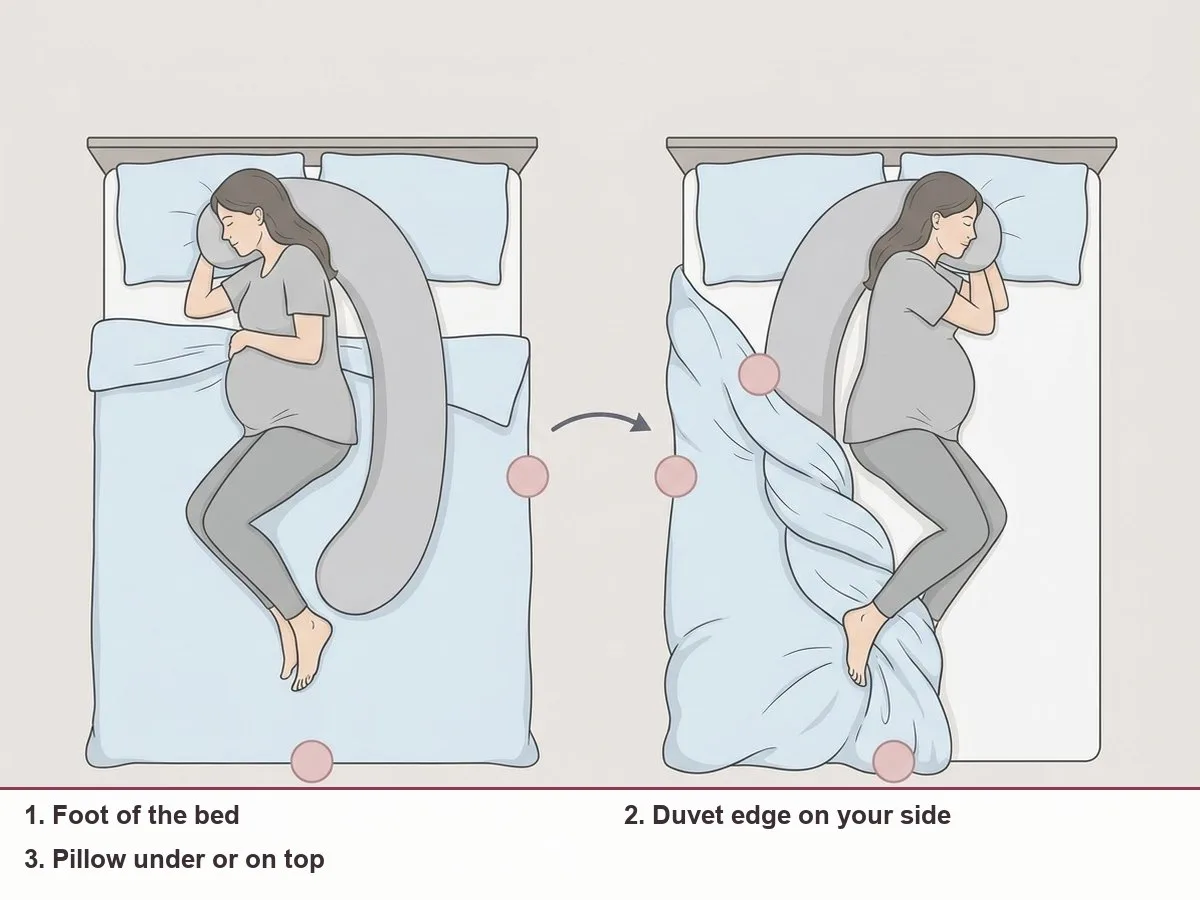
A pregnancy pillow tangles in the duvet when the duvet is pinned somewhere and your turn drags it across the pillow. Find where it is pinned with one slow turn, then change only one layer per night.
- Most common: a duvet tucked in at the foot.
- Next: the pillow lying on top of the duvet.
- Do not: tie or strap the pillow to the bed.
Why does a pregnancy pillow get tangled in the duvet?
When you turn, your body pulls the duvet with you. If the duvet is held at one end, or the pillow is caught on it, the pull drags the pillow, twists the cover or rolls the duvet into a rope.
3:20 a.m.
Diana was 31 weeks and had a routine: wake up, need the bathroom, turn. Every turn, the long pillow came half with her and half stayed, and the duvet ended up wound around its tail like a rope. Getting out of bed meant unwinding all of it in the dark. Getting back in meant doing it again, more slowly, so she would not wake Luis.
"Then you have to try to escape the legion of pillows and quilts you've assembled around yourself every time you have to wake up to pee."YouTube comment on a pregnancy sleep video
"it's not so easy to turn sides what with having to adjust the pillows, lifting your body up to turn, too much work"YouTube comment on a pregnancy sleep video
The pillow is not fighting you. Something is holding the duvet, and you are the one pulling.
How do you find where the duvet snags?
Do one slow turn with the lights on and watch the layers. Note where the pillow and the duvet are before the turn and after it.
- Set up as you would at bedtime. Same pillow, same duvet, same side of the bed.
- Before you turn, check three spots: the foot of the bed, the edge on your side, and whether the pillow is under or on top of the duvet.
- Turn slowly once, the way you do at night.
- Look again at the same three spots. Which one moved? Which one stayed pinned?
- Write down the one spot that changed most. That is your snag point.
If you share the bed, ask your partner to watch from their side. They often see the pull before you feel it.
What should you change for each snag point?
Change the layer at the snag point, and nothing else, for one night. Then repeat the check.
| Snag point | What you see | One change to try |
|---|---|---|
| Foot of the bed | Duvet tight at the bottom, pillow tail dragged sideways | Untuck the duvet at the foot on your side |
| Pillow on top of the duvet | Pillow slides off with the duvet when you turn | Put the pillow under the duvet, on the sheet |
| Duvet edge on your side | Edge rolls under you, then pulls the pillow | Leave more overhang on your side |
| Duvet cover | Duvet bunches inside the cover and twists | Check the cover's corner ties or closures are done up |
| One shared duvet | Your turn pulls it off your partner too | Try a second, lighter blanket on your side |
One change per night is the whole trick. Change three things at once and you will never know which one worked.
What should you not do to stop the tangling?
Do not tie, strap or pin the pillow to the bed, and do not try to fix yourself in one position. You need to be able to turn and get up freely.
- No cords or straps from the pillow to the bed frame.
- No tucking the pillow tightly under the fitted sheet.
- No heavy layers piled on to hold the pillow down.
- No pillow layout that makes getting out of bed slow.
A pillow that stays put because it is fixed in place also stays put when you are trying to get up quickly. Comfort comes from fewer snags, not more anchors.
When is the pillow shape the real problem?
When the pillow is long enough to cross the whole duvet. A C, U or long body pillow lies across more of the bedding, so it has more places to catch.
If you have tried each layer change and the long pillow still drags, smaller pieces at your bump and back sit inside your own space and cross less of the duvet. That is often the change that ends it. For how a pillow works with two people under one duvet, see our two-person bed trial.
Diana did the one-turn check on a Sunday afternoon and found it in thirty seconds: the duvet was tucked in tight at the foot, and the pillow's tail was pinned under it. She untucked her side. Two nights later she switched to two small wedges under the duvet. The next time she got up at 3 a.m., she just got up. Luis did not even stir.
Frequently asked questions
Should a pregnancy pillow go under or over the duvet?
Usually under, on the sheet. A pillow on top of the duvet tends to slide off with it every time you turn.
Why does my duvet twist around my pregnancy pillow?
Usually because the duvet is pinned at the foot or edge. When you turn, the free part follows you and winds around the pillow. Untucking the pinned end is the first thing to try.
Can I tie my pregnancy pillow to the bed so it stays put?
No. Do not tie, strap or pin a pillow to the bed or to yourself. You need to be able to turn and get up freely.
Would separate blankets help?
They can, if your turn is pulling a shared duvet. Try a lighter blanket on your side for one night and repeat the one-turn check.
If the long pillow still drags after every fix
If you have changed each layer and a long pillow still pulls the duvet, smaller pieces may suit you better. The Relvay 3-Piece sits at your bump and back under the duvet, instead of running the length of the bed.

Two wedges for bump and back, joined by a flat strap, about as wide as your torso. Keep a regular pillow between your knees. $79.99, 90-day returns.
Diana's story is a composite based on real reviews and public posts from pregnant side sleepers. Names and details are changed.