

Relvay makes a pregnancy pillow. We also tell you below when you should not buy one.
The short answer
There is no set week to start using a pregnancy pillow. Start when comfort cues show up: waking to adjust, aching in the morning, or your usual position feeling unstable. For many people that is the second trimester.
- Wait if you sleep well as you are.
- Start when 2+ cues hit 3+ nights a week.
- Before 28 weeks: practice side sleeping.
18 weeks, three different "right weeks"
Most people start looking for a pregnancy pillow because someone gave them a week number. The better signal is usually already happening at night. Here is what that looks like.
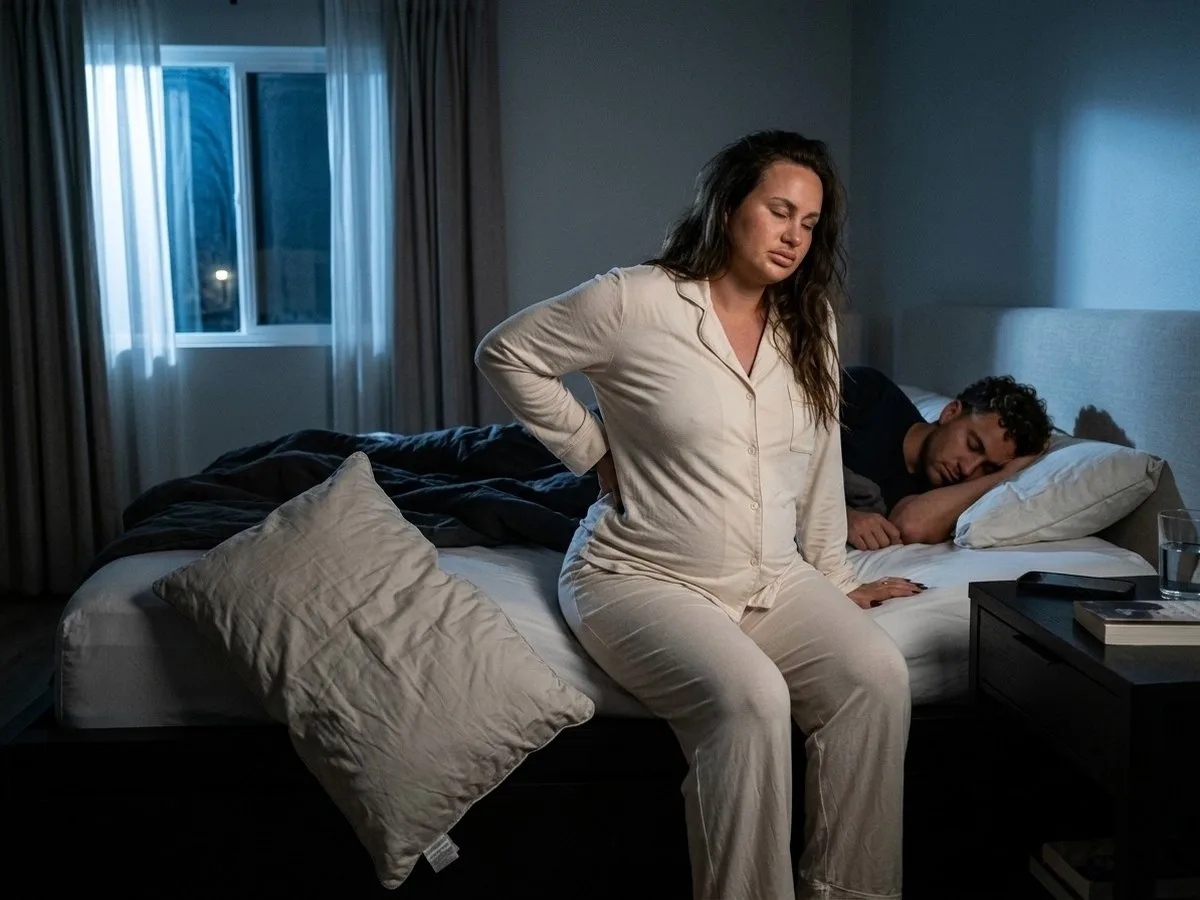
4:05 a.m.
I was 18 weeks, and I had been a stomach sleeper my whole life. That night I woke up for the third time, half twisted, one knee hitched up, my bump pulling in a way that was not pain exactly, just wrong. I lay there in the dark trying to remember what position I used to fall asleep in.
My friend Dana had told me to get a pregnancy pillow at 20 weeks, like it was a rule. My sister said not to bother until the third trimester. An app said 24. I had a note on my phone with all three numbers, and none of them told me what to do at 4 a.m. at 18 weeks.
Ben was asleep, warm and still, the way only people who are not pregnant sleep. I put a folded blanket under my bump, felt a little better, and lay awake anyway, wondering if I was early, late or making it up.
- If you have been told three different "right weeks" by three different people...
- If you are waking up to shift position more often, but it is not bad yet...
- If your usual sleeping position has quietly stopped working...
- If you do not want to buy something too early, or wait until it is too late...
You are not early or late. The week number was never the real signal. Your nights are.
"Rounding 26 weeks, it's starting to feel awkward...not getting to sleep as easy as I used to. Toss and turn all night until I just finally fall asleep."YouTube comment on a pregnancy sleep video
"As my belly grew, it became harder and harder to find a comfortable sleeping position."Amazon review of a pregnancy pillow
"At 20 weeks pregnant I have been having alot of back pain due to no pillow support."Customer review of a pregnancy pillow
What most of us do while we wait
Most people try waiting for a set week, fixing their old position, or asking everyone they know. Each one delays the question your own nights could answer.
- Waiting for the "right week".Hazel had three numbers saved on her phone, and she kept waiting for one of them while her nights got shorter. A calendar week does not know how you slept.A number from someone else's pregnancy.
- Patching the old position.A pillow under one hip to keep sleeping half on her stomach. It worked for a few nights, then the bump made it a twist instead of a rest.Holding on to a position the body is leaving.
- Asking everyone.Her mom said she never needed one. A coworker said it saved her marriage. Both were true for them. Neither was about Hazel.Good stories, wrong data.
- Toughing it out."It is not that bad yet." Then one week it was bad every night, and a new pillow still had to be chosen, ordered and delivered.Waiting until it hurts means waiting days more for delivery.
Why is there no right week to start?
Because the right time depends on three things that change at a different pace for everyone: how your bump is growing, how your sleeping position is changing, and how your nights are going. A week number tracks none of them.
Your bumpSome people show early, some late. The pull on your back starts when your bump does, not when the calendar says.
Your positionStomach and back sleepers have to change sooner. Born side sleepers may feel fine for longer.
Your nightsWaking to adjust, aching in the morning, and dreading turning over are the signals that matter.
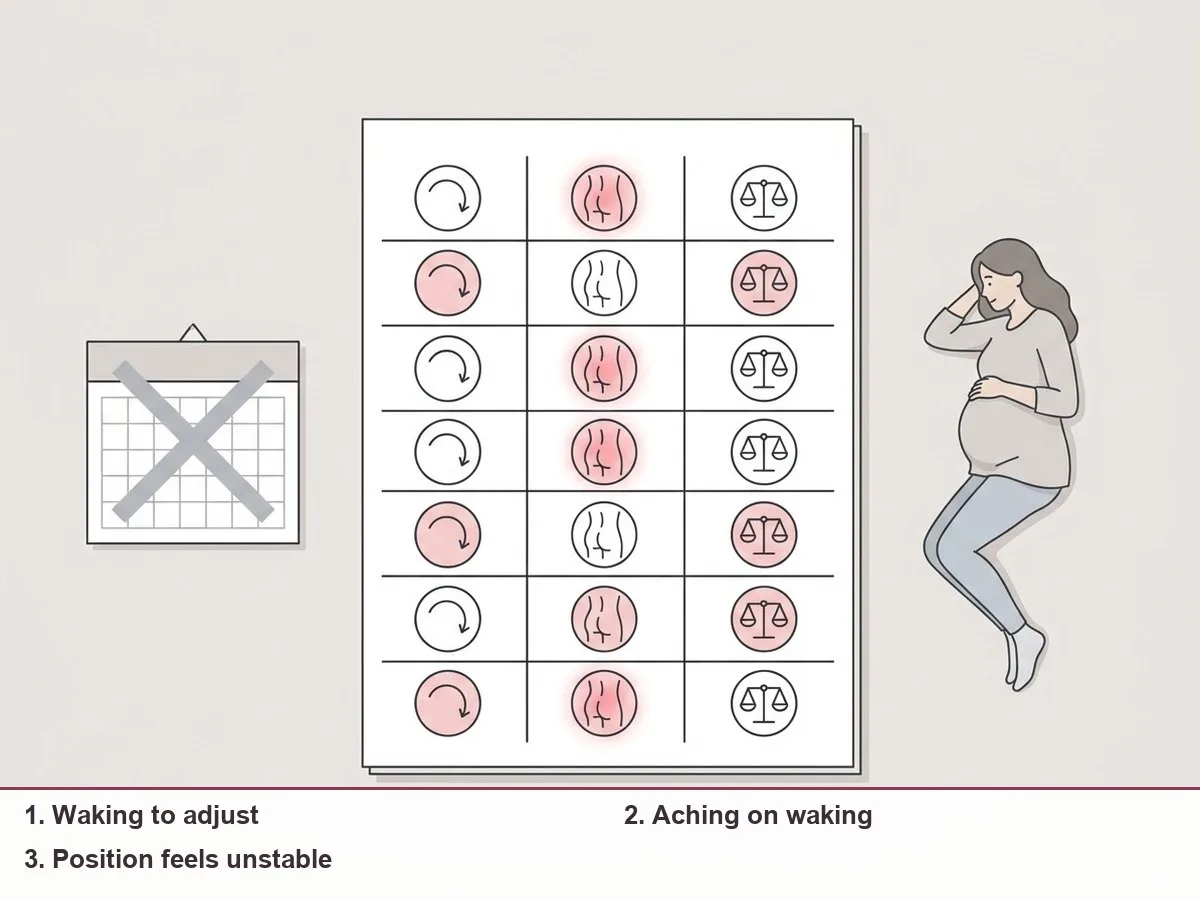
Your calendar tells you how far along you are. Your nights tell you when to start.
Below is the seven-night comfort diary Hazel used, plus ways to try support before you buy anything. Then the setup she ended up with, and why it could change as she grew.
What are the signs it is time to start?
It is time to change your setup when the same comfort cues show up on several nights in a week. These are the most common ones:
- I wake up to shift my position or fix pillows.
- My lower back, hips or bump feel pulled or achy when I wake up.
- My usual sleeping position feels awkward or unstable.
- I put something under my bump without thinking about it.
- Turning over takes effort and wakes me up properly.
- I am more tired in the morning than I should be.
One cue on one night is just a night. Two or more cues on three or more nights in a week is a pattern, and patterns are when support starts to help.
Sharp pain, pain that keeps you awake, or anything that worries you is something to raise with your midwife or OB-GYN. A pillow is a comfort aid, not a treatment.
The 7-night comfort diary
Keep a one-line note each morning for a week. It takes ten seconds, and it turns a vague feeling into an answer.
| Night | Woke to adjust? | Ached on waking? Where? | Position felt stable? | What I used |
|---|---|---|---|---|
| Mon | Yes, twice | Lower back | No | Head pillow only |
| Tue | No | No | Mostly | Folded blanket under bump |
| Wed | Yes, three times | Hip | No | Head pillow only |
| Thu | Yes, once | Lower back | Mostly | Blanket and knee pillow |
| Fri | Yes, twice | No | No | Blanket slid off |
| Sat | No | No | Yes | Blanket and knee pillow |
| Sun | Yes, twice | Lower back | No | Blanket slid off |
This is Hazel's week, as an example. Five nights with two or more cues. And the good nights were the nights she had support under her bump and between her knees. That was her answer, at 18 weeks.
Do you need a pregnancy pillow before 28 weeks?
You do not need a special pillow before 28 weeks, but it helps to get used to side sleeping earlier. The NHS advises going to sleep on your side from 28 weeks, either side, with pillows under your bump and between your knees.
If you are a stomach or back sleeper, practicing side sleeping in the second trimester is easier than switching overnight later. Regular pillows can do that job. If they keep sliding away while you are learning, that is a cue too.
Can you try support before you buy?
Yes. Try support with what you have before you buy, and if you do buy, choose a return window long enough to sleep on it for a few weeks.
| Try first | What it tells you |
|---|---|
| Folded blanket or towel under the bump | Whether bump support is what you are missing. |
| Regular pillow behind your lower back | Whether back support helps you relax on your side. |
| Regular pillow between knees and ankles | Whether your hips feel better in the morning. |
| Borrowing a friend's pregnancy pillow for a few nights | Whether you like a shaped pillow at all, and which size feels right. |
| Buying with a long return window | A real trial in your own bed. Check if the window counts from delivery and who pays return shipping. |
For the full regular-pillow setup, see Do you need a pregnancy pillow?. Before ordering, our buying checklist covers bed size, care and returns.
Which type works best if you start early?
If you start early, choose support that can grow with you: something small now that adjusts later, instead of the biggest pillow on day one.
| U or C full-body | Single wedge | Long body pillow | Two wedges strapped together | |
|---|---|---|---|---|
| Feels right early on | Often too much | Yes | Yes | Yes |
| Bump and back at once | Yes | One or the other | One side | Both |
| Adjusts as the bump grows | No | Limited | Somewhat | Set the distance |
| Bed space | Much of a queen | Very little | Medium | Stays on your half |
What changed when she followed her cues?
When she followed her own cues instead of a number, Hazel started at 18 weeks with a small setup and adjusted it as she grew, instead of waiting and catching up.
Hazel showed Ben the diary on Sunday. "Five out of seven," she said. He read it and said, "So, now?" So, now. She ordered two small wedges joined by a strap, kept her regular pillow between her knees, and practiced sleeping on her side while it was still easy to learn.
The first week she moved the wedges closer together. By 26 weeks she had moved them apart again. Most nights she woke up only once. On a Saturday morning in spring Ben brought her coffee and found her still asleep on her side, one hand on the bump, the diary note on her phone finally deleted.

Frequently asked questions
When should you start using a pregnancy pillow?
When comfort cues show up on several nights a week: waking to adjust, aching in the morning, or your usual position feeling unstable. For many people that is the second trimester, but there is no set week.
Is it too early to use a pregnancy pillow in the first trimester?
Not if it helps you sleep. Most people do not need one that early, but if you already wake to adjust or ache in the morning, support is fine at any stage.
Do I need a pregnancy pillow before 28 weeks?
Not necessarily. The NHS advises going to sleep on your side from 28 weeks, and practicing earlier helps. Regular pillows can do that job if they stay in place.
How do I know if I need a pregnancy pillow?
Keep a one-line note each morning for a week. Two or more comfort cues on three or more nights is a pattern worth acting on.
Should I order a pregnancy pillow before I need it?
Order when the cues start, not after they get bad, because delivery takes days. Choose a return window long enough to sleep on it for a few weeks.
Where the Relvay 3-Piece pillow fits in
The Relvay 3-Piece is the kind of small, adjustable two-wedge set Hazel started with. It suits an early start because you can set the distance between the wedges as your bump grows.
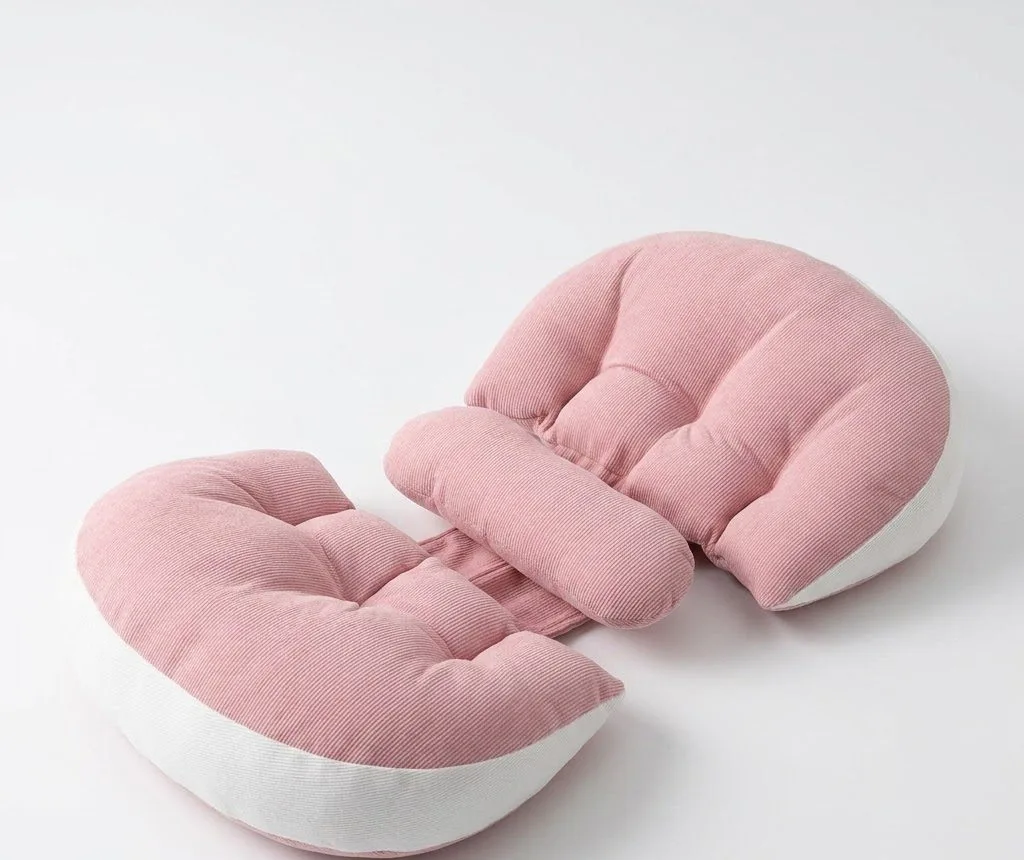
1. The bump wedgeA crescent-shaped wedge that tucks under your bump, thin edge toward your belly button, so the weight is not pulling on your back.
2. The back wedgeThe same shape, snug against your lower back so it has something to rest against.
3. The strap and small cushionA flat strap runs under you and joins the two wedges, so they stay together instead of drifting apart. A small oval cushion sits on the strap between them. You can set the distance as the bump grows.
Each wedge is about 17 by 13 inches and about 4 inches thick at its outer edge, tapering thinner toward your body (supplier measurement). Opened out, the set is roughly as wide as your torso, so it stays on your half of the bed and you keep your normal head pillow. Soft ribbed pink fabric on top, white sides. It is small enough to pack for a trip.
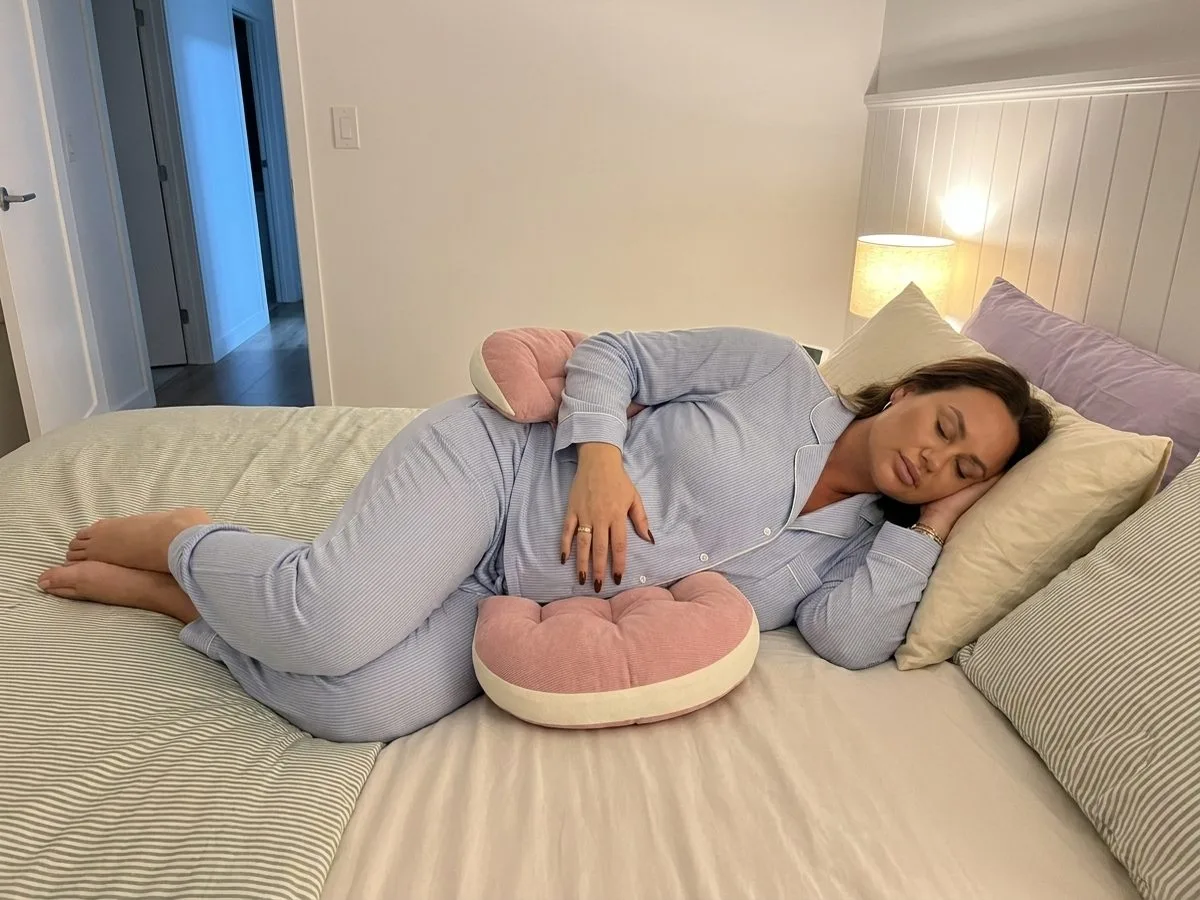
What it does not do: it does not go between your knees. Keep a regular pillow there, the way the NHS suggests. That combination covers all three points without a giant pillow.
Probably not for you if
- You sleep well as you are and have no cues yet.
- Regular pillows are doing the job in your diary.
- You want free return shipping. With us you pay it unless the item arrives faulty.
Made for you if
- Your diary shows two or more cues on three or more nights.
- You want bump and back support that you can adjust as you grow.
- You want 90 days from delivery to try it in your own bed.
Try it for 90 nights
Sleep on it through the weeks that matter. If it is not right for you, email us within 90 days of delivery and send it back for a refund. Return shipping is on you unless it arrived faulty.
$79.99
90-day money-back guarantee · Free US shipping over $70 · 3 pieces, one set
Check price and availabilityHazel's story is a composite based on real reviews and public posts from pregnant sleepers. Names and details are changed.