
Relvay makes a pregnancy pillow. We also tell you below when you should not buy one.
The short answer
Keep following what your care team told you, and ask them about the conflict. General advice is written for most people. Your plan was made for you, and only your team knows why.
- Write down both versions, with source and date.
- Ask one clear question at your next contact.
- New symptoms mean calling now, not waiting.
Why does online sleep advice disagree with what you were told?
Mostly because general advice is written for the average pregnancy, while your instructions take your history into account. Sources also differ by country, by date, and by how much they simplify.
Take sleep side as an example. The NHS says going to sleep on your side, either left or right, is the safest position. Some popular articles still describe the left side as ideal, while adding that the right side is also fine. Read quickly, those sound like two different rules. Read slowly, they mostly agree.
11:20 p.m.
I was 27 weeks and lying in bed reading on my phone, which I know is the worst thing to do. At my last appointment my midwife had told me which way to sleep and how to prop myself up for my heartburn. It made sense in the room.
Then an article said almost the opposite. Then a forum thread said the article was out of date. Luis was asleep. I lay there trying to work out which of three strangers to believe, and I did not sleep for an hour.
The question is not who is right in general. It is which advice was meant for you.
Which advice should you follow tonight?
The instructions your care team gave you, until they tell you otherwise. An article cannot see your notes, your scans or your history.
If the conflict really worries you and cannot wait, call your midwife, the maternity unit or your doctor's after-hours line and ask. That is what those lines are for. Do not quietly switch to the online version and plan to mention it later.
And if you cannot remember exactly what you were told, that is common too. Write down what you think you heard, and ask them to confirm it.
How do you write the conflict down?
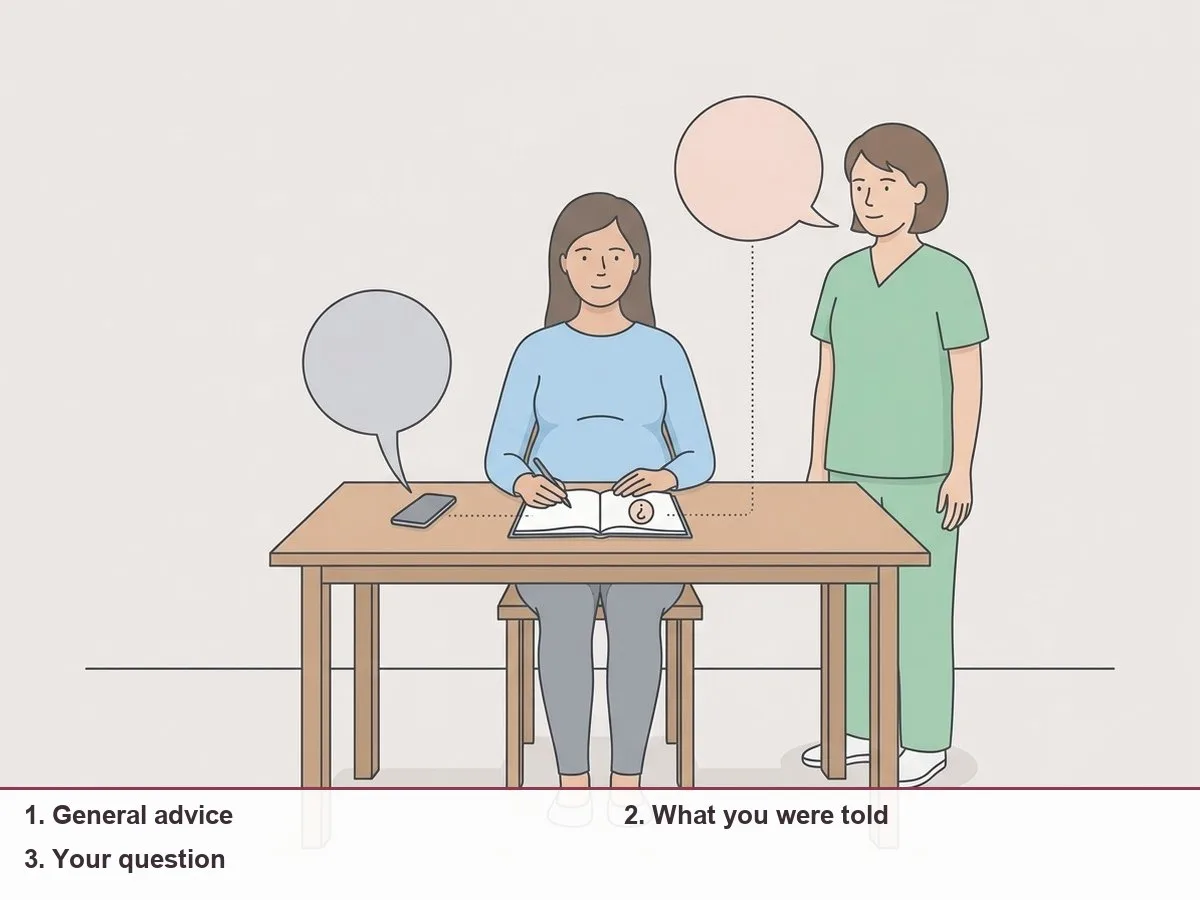
Use one row per conflict: what the general advice says, what you were told, where each came from and when, and the exact question you want answered. It takes five minutes and turns a worry into a question.
| Topic | General advice says | Source and date | I was told | By whom, when | My question |
|---|---|---|---|---|---|
| Which side | Left is best | Article, no date shown | Either side is fine | Midwife, 26-week visit | Is there any reason I should prefer one side? |
| Propping up | Sleep flat | Forum post | Raise head and chest for heartburn | Midwife, 26-week visit | How high, and for how long? |
| Naps | Only matters at night | Friend | Not discussed | Does the same advice apply to daytime naps? |
- Copy the exact words from the article or post, not your summary of them.
- Note the date and country of the source if you can find them.
- Write what you were told as precisely as you remember, and who said it.
- Turn each row into one question that can be answered in a sentence.
How do you judge where the online advice came from?
Look at who wrote it, when, for which country, and whether it is about everyone or a specific group. Those four things explain most conflicts.
- Who: a health service, a hospital, a professional body, a brand, or an anonymous post?
- When: is there a "last reviewed" date? Guidance gets updated.
- Where: advice from another country can use different wording or timing.
- For whom: is it for all pregnancies, or for twins, a specific condition, or after a particular week?
- Does it say why? Advice that explains its reason is easier to check against your own plan.
Barwon Health in Australia, for example, advises settling to sleep on your side for every sleep, including returning to sleep after waking and daytime naps. Some other pages only mention night-time. Neither is wrong for the general reader. Your care team can tell you how it applies to you.
What should you ask your care team?
Ask short questions that name both versions. "I read X, you told me Y, which should I follow and why?" gets you a clear answer and the reason behind it.
- "I read that only the left side is safe. You said either side. Is there anything about my pregnancy that changes that?"
- "You told me to prop myself up. Should I still do that if the heartburn settles?"
- "Does this advice apply to naps as well as nights?"
- "Will this change later in my pregnancy? When should I check again?"
- "Where can I read the guidance you are using?"
Ask them to write the answer down, or write it yourself before you leave. Next time a post contradicts it, you will have their words in front of you.
Raquel took her sheet to the next appointment. Her midwife read the three rows, answered each in a sentence, and explained why the heartburn advice was specific to her. Raquel wrote the answers in the same notebook. The next time a post told her something different, she checked the notebook and went to sleep.
When is it not a question for your next appointment?
If the conflict comes with a new or worrying symptom, call now. The sheet is for advice questions, not for symptoms that need checking today.
- You have a bad headache, changes in your vision, or sudden swelling of your face, hands or feet.
- You have pain that is new, sharp or does not go away.
- Worry about doing it wrong is keeping you awake night after night.
- Anything that simply feels wrong to you.
If worry about your sleep position itself is what keeps you up, our guide on when worry about sleep position keeps you awake may help. For what the side-sleeping guidance says in the first place, read left or right side in pregnancy.
This sheet helps you ask clear questions. It does not decide which advice applies to you. Only your midwife or doctor can do that.
Frequently asked questions
Should I follow online pregnancy sleep advice or my midwife?
Follow your midwife or doctor. Online advice is written for most people, while your care team knows your history. If the two conflict, ask them about it.
Why do pregnancy sleep guidelines differ between websites?
Sources differ by country, date and how much they simplify. Many differences, such as left side versus either side, are smaller than they first look.
Is it okay to sleep on my right side if I was told either side is fine?
The NHS says going to sleep on your side, either left or right, is the safest position. If your care team gave you a different instruction, follow theirs and ask why.
What if I cannot remember exactly what my midwife said?
Write down what you think you heard and ask them to confirm it at your next contact, or call if it cannot wait.
How do I know if a pregnancy website is reliable?
Check who wrote it, when it was last reviewed, which country it is from, and whether it explains its reasons. Health services and hospitals are a good starting point.
If comfort is the real reason sleep advice is hard to follow, our pregnancy pillow buying checklist covers support options. It does not replace anything your care team told you.
Raquel's story is a composite based on real reviews and public posts from pregnant sleepers. Names and details are changed.