
Relvay makes a pregnancy pillow. We also tell you below when you should not buy one.
The short answer
Worry about sleep position is common in later pregnancy, and it is worth raising with your midwife or doctor when it keeps you awake. The NHS advice is to go to sleep on your side, not to watch yourself all night.
- Log it: how often you wake to check, and how long you stay awake.
- Ask: what to do if you wake in another position.
- Mention worry that spills into your days.
Is it common to worry about your sleep position in pregnancy?
Yes. In a 2025 Australian study of women at 32 to 36 weeks, published in Women and Birth, 23% of those surveyed reported moderate or high anxiety about their sleeping position. The researchers concluded that position advice should be balanced against possible harms to sleep and mental health.
That conclusion matters. The people who wrote the study are telling you that worry like this is a real cost, not a sign that you care too much or are doing it wrong.
1:55 a.m.
I was 33 weeks and I had set my phone to buzz every two hours. Not for anything medical. Just so I could check how I was lying. Then I stopped needing the alarm, because I was waking up on my own, heart going, before I even opened my eyes.
Chris asked me one morning why I looked like I had not slept. I said I was fine. I did not know how to say "I am scared of my own sleep" out loud without sounding a bit unhinged.
Checking all night is not the same as following the advice. It is a loop, and loops are worth getting help with.
What does the sleep position advice actually ask of you?
It asks you to go to sleep on your side, either left or right. The NHS also says that if you wake up in a different position, you can simply turn onto your side and go back to sleep without worrying.
So the advice is about how you settle down, not about staying awake to watch yourself. That one detail is easy to lose at 2 a.m., when every article you read before bed is still running in your head.
- At lights out: settle on whichever side is comfortable, with pillows under your bump and between your knees if they help.
- If you wake and have moved: turn back to your side and go back to sleep.
- Either side is fine. Our guide left or right side in pregnancy explains where that advice comes from.
If you want a step-by-step on what to do when you wake in another position, read questions and next steps after waking in pregnancy. This page is about the worry itself.
What does a position-checking worry loop look like?
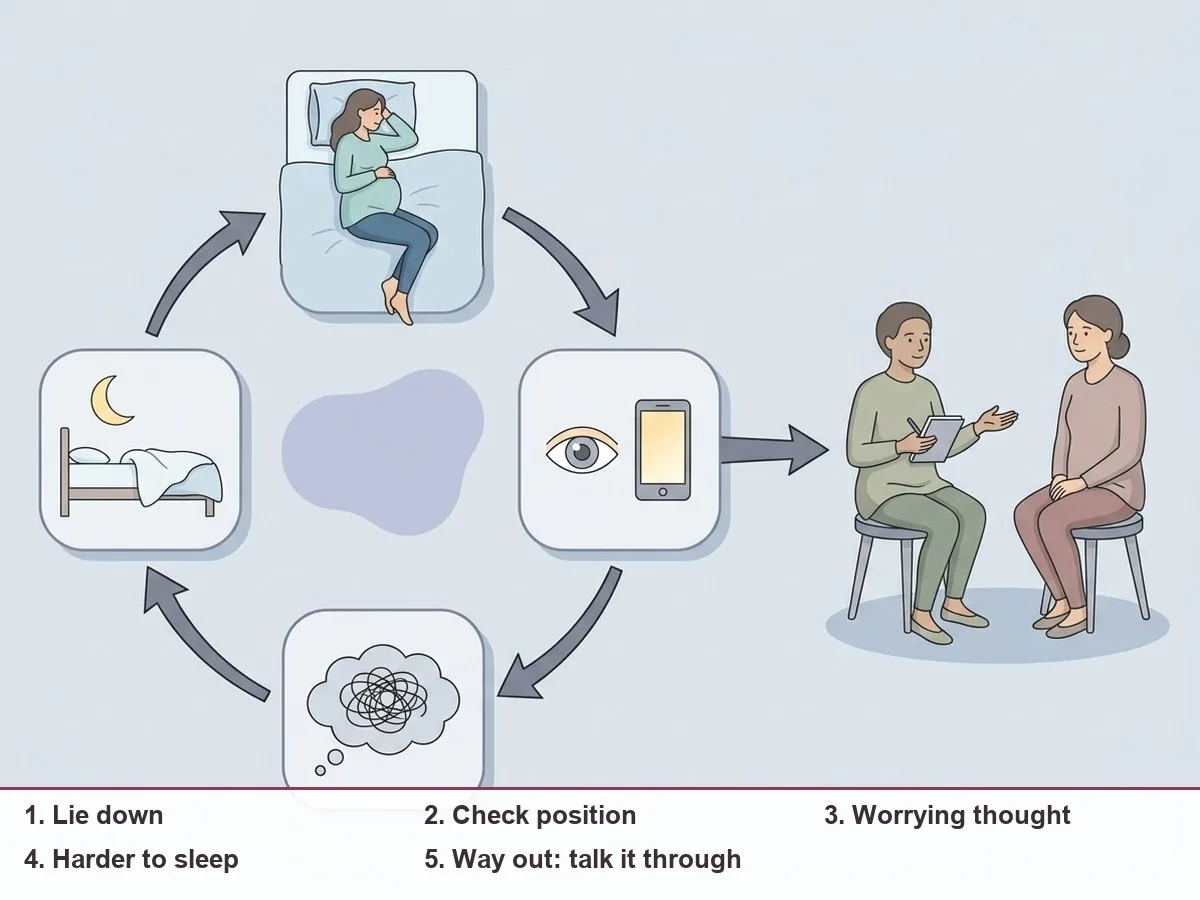
It usually goes: you lie down, you check, a worrying thought arrives, your body wakes up, sleep gets harder, and you check again. Each check feels like it helps for a moment and makes the next one more likely.
The checkWaking to see how you are lying, setting alarms, asking your partner to watch.
The thought"What if I have been like this for hours?" "What if I did something wrong?"
The costLying awake, a racing heart, then dragging through the next day.
You do not need to name this or diagnose it. You only need to notice it well enough to describe it to someone who can help.
What should you write in a worry log?
Write it the next morning, not during the night: how many times you woke to check, any alarms or habits you used, roughly how long you lay awake, the thought that came, and how the day went.
| Night | Woke to check | Alarms or habits | Awake for roughly | The thought | Next day |
|---|---|---|---|---|---|
| Mon | 4 times | Phone alarm every 2 hours | 1 hour in total | "What if I missed it?" | Teary at work |
| Tue | 3 times | No alarm, woke anyway | 40 min | Heart racing on waking | Tired, irritable |
| Wed | 5 times | Asked partner to check | Most of the night | Could not stop going over it | Could not concentrate |
- Morning only. Writing during the night turns the log into one more thing to check.
- Rough numbers are fine. "About an hour" is enough.
- Write the thought in your own words. It helps the person you talk to understand what is actually happening.
- Include the day. Worry that spills into your days is a key detail for your care team.
What should you ask your midwife or doctor?
Bring the log and say plainly that worry about your sleep position is keeping you awake. The NHS says you can be open with your midwife or GP about how you feel, and that you are not going to be judged.
- I am waking to check my position several times a night. Is that something you want me to do?
- What exactly should I do if I wake up and have moved?
- Is anything about my pregnancy a reason to be more careful than the usual advice?
- The worry is affecting my days. Can we talk about that too?
- Is there support I can be referred to, such as a talking therapy?
The NHS notes that anxiety in pregnancy can often be helped with a talking therapy, such as cognitive behavioural therapy, and that your GP or maternity team can tell you how to access it.
Ruby brought four mornings of notes to her 34-week appointment and read the questions off her phone, because she knew she would not get them out otherwise. Her midwife went through what to do if she woke up having moved, and asked how the worry was affecting her days. They talked about support she could be referred to.
She turned the phone alarm off that night. She still woke sometimes. But she had an answer for what to do next, and she was not carrying it alone.
When is it more than worry about position?
Talk to your GP or midwife if worry is hard to control and affects your daily life, not only your nights. The NHS lists signs such as feeling tense, constant worry about the pregnancy, trouble concentrating, a racing heartbeat and panic attacks.
- You feel anxious most of the time, day and night.
- You have panic attacks, or wake up with your heart pounding.
- You cannot concentrate at work or at home.
- You feel hopeless, or have lost interest in things you used to enjoy.
- You are avoiding sleep because of the worry.
If you or someone close to you is in a mental health crisis, get urgent help straight away through your emergency services or local crisis line.
This page and log help you describe what is happening. They cannot assess anxiety or sleep. A pillow is a comfort aid, not a fix for worry. Only your midwife, doctor or a mental health professional can help you work out what you need.
Frequently asked questions
Is it normal to be anxious about sleeping position while pregnant?
It is common. In one 2025 Australian study, about a quarter of women in late pregnancy reported moderate or high anxiety about their sleeping position. If it keeps you awake, tell your midwife or doctor.
Should I set an alarm to check my sleep position?
The NHS advice is to go to sleep on your side and, if you wake having moved, turn back and go back to sleep. Ask your midwife before adding alarms, since broken sleep has its own cost.
What should I do if I wake up and I have moved?
The NHS says to turn onto your side and go back to sleep without worrying. If you have specific concerns about your pregnancy, ask your midwife what applies to you.
Can a pregnancy pillow stop the worry?
No. A pillow can make side sleeping more comfortable, but it is not a fix for anxiety. If worry is keeping you awake, the most useful step is talking to your midwife or GP.
Who can I talk to about anxiety in pregnancy?
Your midwife, GP or maternity team. The NHS says anxiety in pregnancy can often be helped with talking therapy, and they can tell you how to access support.
If physical discomfort is part of what keeps you up, alongside the worry, our pregnancy pillow buying checklist covers comfort and fit. It is not a fix for anxiety, and it is fine to skip it.
Ruby's story is a composite based on real reviews and public posts from pregnant sleepers. Names and details are changed.